



Updated 2026-09-22
Do professional backpacks pass office dress codes now?
Yes, a professional backpack now clears most office dress codes, including fairly formal ones, provided the bag is structured, dark, and leather or leather-look rather than sporty. Dress codes loosened after 2020, and the test shifted from category to construction: shape, material, finish and hardware decide whether a backpack reads polished or casual.
Why does carrying a professional backpack still feel like breaking a rule?
The backpack's image problem is memory, not policy. Most of us learned the shape as a schoolbag and then as a hiking pack, and that association outlived the workplace rules it belonged to. Nobody is going to stop you at reception. The anxiety is social, and social anxiety is harder to argue with than a written rule.
Daniel, three years into a corporate law firm, keeps a leather backpack in the boot of his car and swaps into a briefcase two streets from the client's office. No one asked him to. He has never seen a colleague pulled up over a bag. He is managing a feeling rather than a regulation, and the research on workplace dress has a name for that: Babson organisational behaviour professor Emily Rosado-Solomon frames success at work as a mix of authenticity and conformity, and notes that unspoken norms about looking the part have not gone anywhere, even where the formal code has softened. Daniel is not paranoid. He is reading an unwritten norm and paying a small tax to satisfy it.
The catch is that unwritten norms move, and this one already has. Fast Company has covered how difficult work dressing has become for younger professionals now that the old signposts are gone. When the signposts go, people over-correct. If you can feel the rule, you are almost certainly standing well inside the safe side of a line that moved years ago.

How office dress codes quietly changed their position on bags
Dress codes relaxed faster than the instincts attached to them, and bags were rarely what those codes policed in the first place. Fast Company reports that in the years after the pandemic, workplace dress codes became the most casual they have ever been, and that as the old formality fell away a new unspoken pressure took its place: fitting in through ultracasual clothing. The policing did not stop. It changed direction.
That matters for what you carry. Raconteur quotes trend forecasters expecting a slight pendulum swing back towards formality as companies pull people into the office full time, while doubting it becomes permanent, with the long historical drift towards casual continuing underneath. So anyone dressing for a stricter office day is standing in a genuinely mixed moment rather than an obvious one.
Priya, an operations lead at a fintech, found her staff handbook asked for smart attire on client-facing days and said nothing whatsoever about bags. That is the normal case. The code delegates the decision to you, which is more freedom and more responsibility at the same time. And the signal still lands somewhere. Raconteur's history of office workwear argues that the symbolism of workwear has not disappeared but transformed: hierarchy survives even in plain t-shirts, where Mark Zuckerberg's reportedly cost several hundred dollars apiece. When the suit stops doing the signalling, the object in your hand starts.


What makes a professional backpack read formal rather than casual?
Four variables decide it: structure, material, silhouette and hardware. Colour matters less than people assume. Visible technical detailing matters far more.
Structure is the first test. A formal backpack holds its shape when you set it down empty beside a chair; a casual one collapses into a heap and announces itself every time it hits the floor in a meeting. Silhouette is second. Flat panels, square corners and a depth of roughly 12 to 15 centimetres read as a case worn on the back, while anything that bulges, tapers or rolls at the top reads as outdoor kit. Straps are third, and the most commonly missed: narrow, flat, dark straps disappear against a jacket, whereas padded bolsters, sternum clips, daisy chains, bungee cord and contrast mesh do the opposite. Hardware finishes the argument. Matte black, gunmetal and a little polished silver behave themselves. Bright zip pulls and reflective trim do not.
Gear Patrol has built an entire editorial category on this distinction, framing its coverage around the backpack you can actually wear to work rather than the best backpack outright, and treating leather construction as the marker separating an everyday-professional bag from a casual one. That framing exists because the category split is real.

The four-metre test for any office backpack
Judge the bag the way your colleagues will. Stand it on the floor, step back four metres, and look at it as an object in a room rather than as a purchase you are justifying. If it looks like luggage, you are fine. If it looks like equipment, you are not. Want the harsher version? Photograph it on your phone. A camera flattens texture and exposes a slouching panel immediately.
Why did vegan leather close the formality gap for office backpacks?
Vegan leather earned the backpack its place in meetings because it delivers a leather surface without leather's weight, cost or upkeep, and weight was the exact reason structured leather backpacks were so rare before.
The difference is how the surface handles light. Coated vegan leather has a soft, matte, slightly grained finish that absorbs light rather than bouncing it, which is why it photographs like a formal object under office downlights. Nylon and polyester carry a faint sheen and a woven texture the eye files under sportswear at a glance, even in black. Canvas creases into slouch within weeks. Ballistic weave reads competent but technical. Vegan leather also behaves differently in construction: because it is a coating over a stable backing, it can be cut and joined into flat panels with defined edges, so a bag can be built square instead of soft. That is why a vegan leather backpack can look like a briefcase that happens to have straps.
One honest caveat, because the material gets oversold. Researchers writing in The Conversation argue that vegan leather is often not as sustainable or eco-friendly as brands claim. Buy it for what it demonstrably does, which is hold a formal shape at a fraction of the weight of calf leather. Treat the environmental story as a separate question with its own evidence.

Can you wear a professional backpack with a suit to a meeting?
Internal stand-ups, hybrid hot-desk days and most external meetings in tech, product, creative and professional services now read perfectly well with a structured backpack, suit included. Boardroom presentations, first meetings in law, private banking and old-line finance, and anything where you will be introduced to a chairman still favour a slim case carried in your hand.
Farah, a product manager splitting her week across two sites, carries the Montreal Business Backpack for the ordinary run of days: 15 L, 1.12 kg, two padded laptop compartments taking a 16-inch MacBook Pro, an anti-theft back pocket and lockable hardware for the train. Nobody in a stand-up has ever looked twice at it, and that is the correct amount of attention for a bag to get.
The pitch is the situation that actually worries people, and it has a clean answer. Tobias, who leads new business at a design studio, carries the Nexus Convertible 3-Way Backpack: 17 L, 1 kg, a 16-inch laptop compartment, concealable backpack straps and a detachable padded shoulder strap. Both straps to the station, straps tucked away in the lobby, then he walks into the room holding a case. Same bag, two registers.
Where a professional backpack still loses to a briefcase
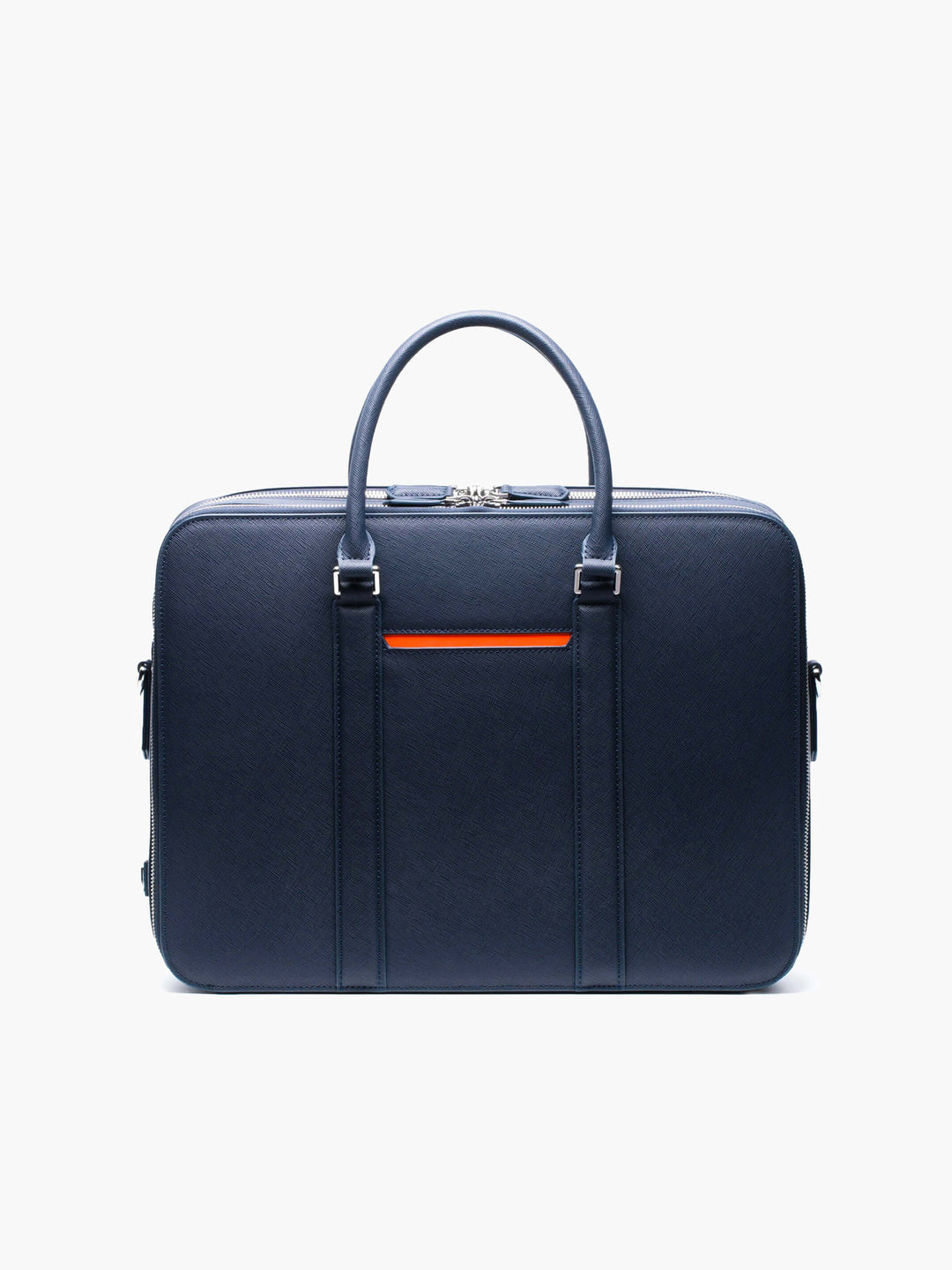
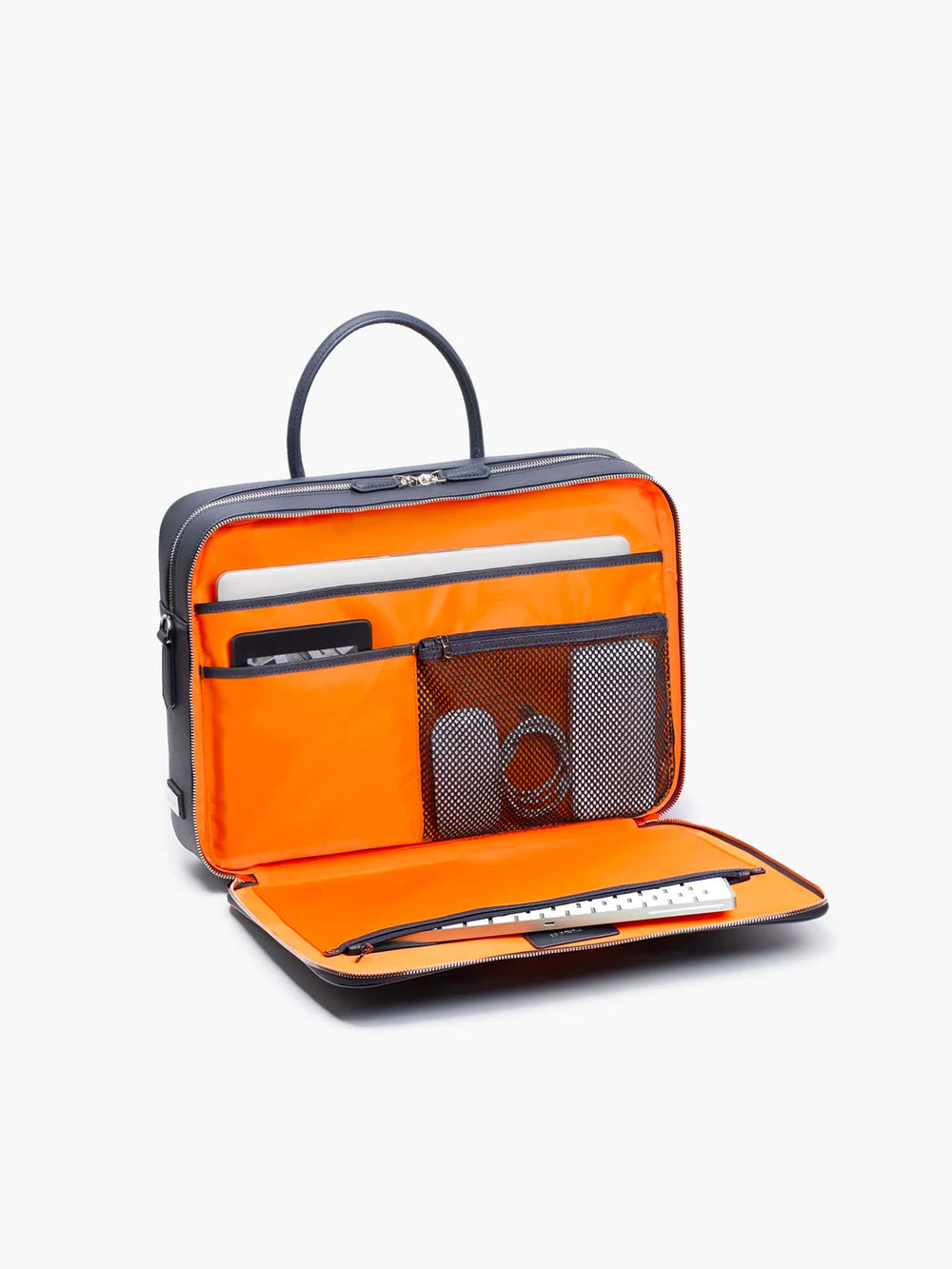
Some rooms are not worth the argument, and a first meeting with a board is one of them. The Manhattan Leather Briefcase is 4.1 L and 1.2 kg with a padded 16-inch laptop compartment: enough for a laptop, a pad and the papers, and nothing else to explain. Keeping one case for the handful of occasions a year that genuinely demand it costs far less than second-guessing your bag every Monday morning.

How do you style a professional backpack so the outfit does the convincing?
Wear it on both straps outdoors, carry it by the top handle indoors, and match the bag's finish to your shoes and belt rather than to your jacket. Those three habits resolve most of the doubt before anyone has formed an opinion.
The tailoring problem is real and worth naming. Backpack straps flatten the shoulder line of a soft, unstructured jacket, and they mark lighter wool. The fix is sequencing rather than sacrifice: straps on for the commute, bag in hand from the building entrance, bag on the chair rather than the table once you sit down. Proportion is the other half of it. The bag should finish between your shoulder line and your waist, never below the seat of your trousers.


Scaling a professional backpack to your frame
Yuki, an analyst at 5 foot 3, was swamped by every 20-litre bag she tried. The Sonnet Leather Backpack sits at 37.5 cm tall, holds 13.2 L, weighs 0.99 kg and takes a 14-inch MacBook upright, so it finishes above her waist instead of at her thighs. Marcus, an account director at 6 foot 2, has the opposite problem: small bags look like an afterthought on him. The Windsor Business Backpack runs 44 cm tall with 20 L, 1.37 kg and a dedicated 16-inch laptop compartment, so it reads deliberate rather than dwarfed. Get the scale right and nobody registers the bag at all. They register you, arriving organised.

What to check before buying a backpack for formal dress codes
Check five things, in this order: whether it stands up empty, whether the laptop sits off the floor, whether the straps lie flat, whether there is a trolley sleeve, and what it weighs before you load it.
Standing up empty is the single best proxy for everything else, because it tells you the panels have structure and the base is reinforced. A bag that folds over beside your chair will look tired in every meeting for the rest of its life. A suspended laptop compartment matters for the same reason it matters in a briefcase: a laptop resting on the base takes the impact each time you set the bag down. Straps should lie flat against the back panel when the bag is carried by the handle, otherwise the formal silhouette only exists while you are wearing it. A trolley sleeve costs nothing in bulk and changes your airport entirely.
Weight is the one people skip. Anything approaching 1.5 kg empty is a decision you will feel by the third day of a conference. Around a kilogram is the comfortable zone for a full working week, and it is the difference between a bag you carry and a bag you notice.
Nadia learned this the expensive way. She bought on colour, discovered the bag slumped onto its side whenever she set it down, and returned it within a week. Nothing about the leather was wrong. The structure underneath it was.
Is a professional backpack the right default for your working week?
If three or more days of your week involve a commute, a laptop and at least one meeting you would call client-facing, a structured vegan leather backpack is the right default, with a slim briefcase kept for the two or three occasions a year that genuinely call for one.
The decision comes down to what your days actually contain. For the person carrying documents, a laptop and a change of clothes, the Axis Leather Backpack holds 20 L at 1.47 kg, opens flat like a suitcase so you are not excavating by touch, fits a 16-inch MacBook Pro and hides a zipped pocket against your back for a passport or a phone. For the week with a flight in it, the Mercator Leather Backpack is 19 L and 1.12 kg in vegan togo leather, with a suitcase sleeve that sits it on a carry-on handle so the whole kit moves as one piece through a terminal.
Here is the honest summary of the whole question. The permission you are looking for already exists, and it is granted by the object rather than by your colleagues. A structured bag in a leather finish, carried in your hand as you walk in, ends the conversation before it starts.
If you want to test that, put the dimensions and weights side by side against the week you actually have. The spec sheet answers this better than any photograph will.
| Setting | Does a backpack work? | What reads right in the room | Maverick & Co. pick | Key spec |
|---|---|---|---|---|
| Internal stand-up or ordinary office day | Yes, without explanation | Structured dark panel bag, parked on the chair rather than the table | Montreal Business Backpack | 15 L, 1.12 kg, fits 16-inch MacBook Pro |
| Hybrid hot-desk day across two sites | Yes | A light bag that stands upright at a shared desk | Sonnet Leather Backpack | 13.2 L, 0.99 kg, 37.5 cm tall, fits 14-inch MacBook |
| External client pitch in tech, creative or consulting | Yes, if carried in by hand | Straps concealed from the lobby onwards | Nexus Convertible 3-Way Backpack | 17 L, 1 kg, concealable straps, fits 16-inch MacBook Pro |
| Boardroom presentation, or a first meeting in law or finance | No, carry a case instead | Slim leather briefcase held in the hand | Manhattan Leather Briefcase | 4.1 L, 1.2 kg, padded 16-inch MacBook Pro compartment |
| Long day with documents, laptop and a change of clothes | Yes | Volume without slouch, and a flat opening | Axis Leather Backpack | 20 L, 1.47 kg, opens like a suitcase, fits 16-inch MacBook Pro |
| Client trip with a carry-on | Yes | A bag that rides the suitcase handle | Mercator Leather Backpack | 19 L, 1.12 kg, suitcase sleeve, fits 16-inch MacBook Pro |
| Taller frame in formal tailoring | Yes | Bag scaled to the torso, finishing above the waist | Windsor Business Backpack | 20 L, 1.37 kg, 44 cm tall, individual 16-inch laptop compartment |
Frequently asked questions
Do law firms and investment banks allow backpacks?
Almost none write bags into a dress code, so the restriction is a norm rather than a rule. In practice, associates and analysts carry structured leather or vegan leather backpacks on ordinary office days without comment. Reserve a slim briefcase for client-facing firsts, court, and board or partner meetings, where a case held in the hand is still the expected object.
What size backpack works best for a daily office commute?
Between 13 and 20 litres covers almost every commuting week. Around 15 litres, like the 15 L Montreal Business Backpack at 1.12 kg, handles a 16-inch laptop, a notebook, a charger and lunch without bulking out. Go to 20 litres only if you regularly carry gym kit or a change of clothes, since a half-empty large bag slumps and looks casual.
How much should a work backpack weigh when it is empty?
Aim for roughly one kilogram empty. The Sonnet Leather Backpack is 0.99 kg and the Nexus Convertible 3-Way Backpack is 1 kg, which leaves your shoulders to carry the laptop rather than the bag. Anything approaching 1.5 kg empty, such as a 20-litre travel-capable build, is a trade you make deliberately for volume, not by accident.
Is vegan leather durable enough for daily commuting?
Good coated vegan leather handles daily commuting well because the coating sits over a stable woven backing, which resists stretching and keeps panels square. It will not develop a patina like calf leather, and it can scuff at corners over years of use. Wipe it with a damp cloth, keep it off rough concrete, and expect several years of service.
Should a work backpack be black or brown?
Black is the safer default in finance, law and consulting because it disappears against tailoring and reads closest to a briefcase. Dark brown or tan works well in creative, tech and product environments, and in offices where brown shoes are common. Match the bag to your shoes and belt rather than your jacket, and keep the hardware matte.