



Updated 2026-09-09
Why your first leather bag under $400 is a career decision
A leather bag under $400 is genuinely good, but the money moves as you climb. Below $200, expect a coated or vegan leather body with leather trim. Between $200 and $300, structured panels, real hardware and woven linings. From $300 to $400, Saffiano and top-grain hides. The biggest jump is construction, not the logo.
Six weeks into her first strategy role, Priya carried her laptop, a printed deck and a charger into a client meeting in the canvas backpack she had used since business school. Nothing went wrong. She just noticed that everyone else's bag had a shape to it, and that she had to kneel on the carpet to dig out her notes while a partner waited.
That is why a first briefcase matters, and it has little to do with impressing anyone. It is about friction. Defined compartments and panels that stay open mean your laptop, notebook and pen are where you left them, and you spend the first thirty seconds of a meeting talking rather than rummaging.
The second reason is financial. A briefcase bought well is equipment you use every working day for years, which makes the honest comparison cost per year of use rather than price against price. Gear editors treat well-made leather goods as long-horizon purchases that age into something better rather than wear out, and that logic makes a considered $300 bag cheaper over five years than three $120 bags that fail at the strap. What follows shows where in the $200 to $400 range that logic kicks in, and where paying more stops changing anything you will notice.
Which leather grades decide what your money actually buys?
Almost every price difference under $400 traces back to one variable: what the hide is, and how much of it survived finishing. Learn five terms and you can read any product page properly.
Full-grain leather is the outermost layer of the hide with the grain left intact, nothing sanded away. It is the strongest part of the skin and the only grade that reliably develops a patina rather than flaking. Top-grain is that same upper layer, lightly sanded and refinished to even out scars: marginally less durable, more uniform in colour, and better at resisting stains, which is why so many structured briefcases use it. Saffiano is not a grade but a finish, a cross-hatch texture pressed into the leather and sealed, which makes it more scratch-resistant and easier to wipe clean than a smooth aniline surface. "Genuine leather" on a label is a marketing phrase rather than a quality tier, and usually indicates split leather from the lower, weaker layers of the hide. Bonded leather is leather dust and offcuts glued to a fabric backing, and it will crack and peel within a couple of years of daily carry.
Two more categories sit inside this price range. Recycled leather reconstitutes genuine leather fibres into a sheet, and its durability depends on the binder and backing rather than on the word "leather". High-performance vegan leather is polyurethane on a woven base, and good versions hold their shape and shrug off rain better than cheap split hide at the same price.
The ninety-second test for real leather
Press a thumbnail into an inconspicuous panel. Full- or top-grain leather marks and then recovers, while a coated surface dents permanently or feels like film over foam. Next, look at a cut edge, at the strap tab or the zip pull: a hide edge shows a dense, fibrous cross-section, whereas a bonded or coated edge shows flat fabric with a skin on top.
Do both checks before you read the price. They take less time than scrolling the reviews, and they settle the one question a product photograph cannot answer.
What construction details make a leather bag last?
Leather grade sets the ceiling on how long a briefcase lives. Construction decides whether it gets there. Daniel, an audit associate two years in, learned this when the shoulder strap on an otherwise handsome bag tore out at the ring on a Tuesday morning, taking a corner of the panel with it. The leather was fine. The attachment point had been stitched and nothing else.
Stitch density is the first thing to look at. Tight, even stitching with more stitches per inch spreads load across more thread and more holes; wide, loose stitching concentrates stress and unzips itself once one thread goes. At every stress point - strap anchors, handle roots, the top corners of the main compartment - you want backstitching or a rivet working alongside the thread rather than thread alone.
Edge finishing is the next tell. Edges that are folded, burnished or sealed keep moisture and abrasion out of the leather's exposed fibres, while raw cut edges fray and darken along the line your hand touches most.
Where a leather briefcase fails first: linings and laptop slots
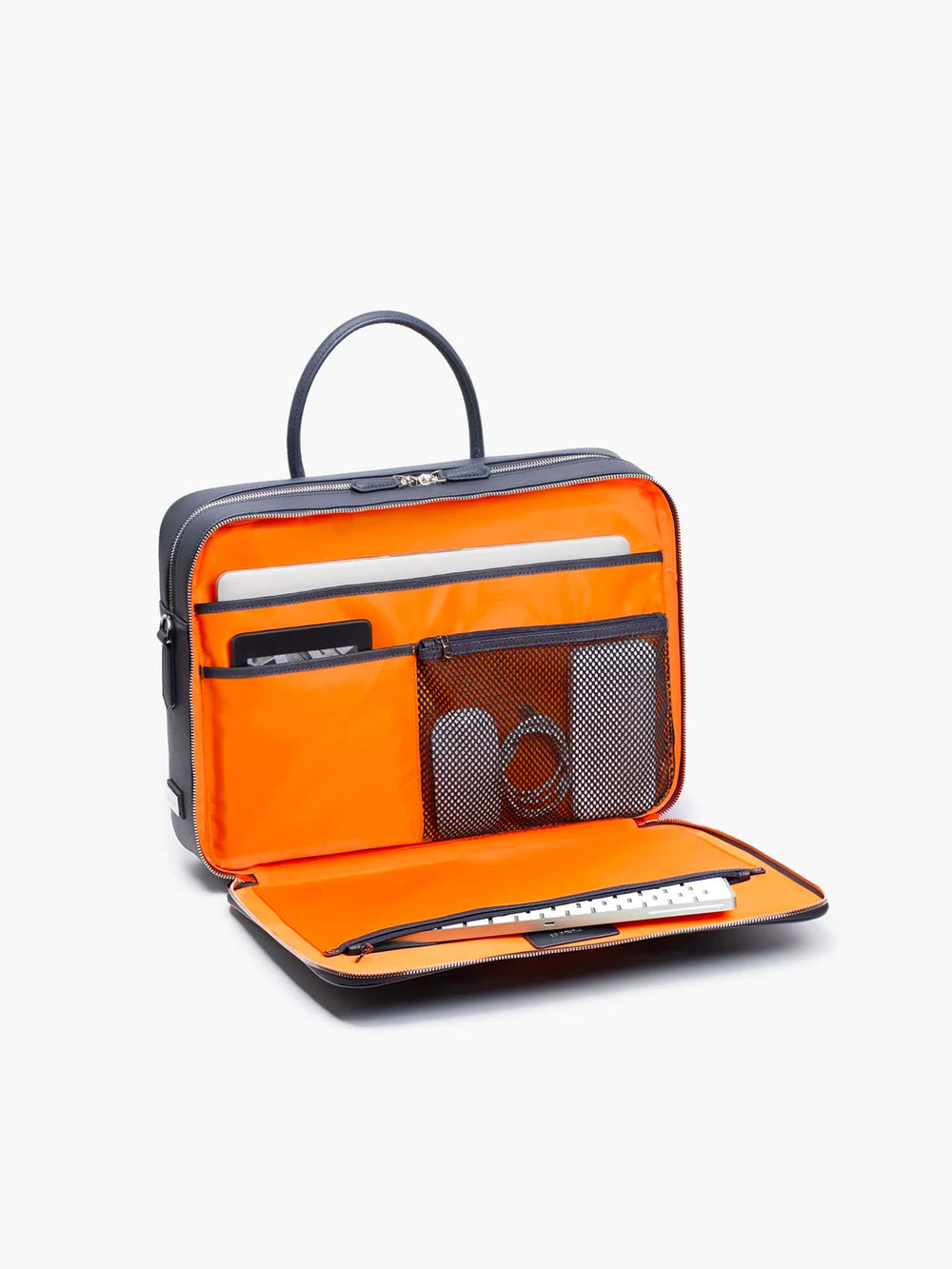
Look inside, because linings are where budgets get quietly cut. A woven lining, typically recycled polyester in this range, takes pen bleed and cable grease without disintegrating, while a thin glued lining separates from the shell and bunches under your laptop.
A padded laptop slot is also not the same as a slip pocket sized for a laptop, as you discover the first time you set the bag down harder than you meant to. Check that the zips run smoothly one-handed while the bag hangs from your shoulder, and that the base has enough structure to stand up empty. A briefcase that slumps flat on the floor will slump around your laptop. Long-term road tests of leather work bags judge exactly this behaviour after months of carry rather than how a bag photographs on day one, which is why the second-hand verdict on a bag is worth more than the launch shot.
What does a leather bag under $400 buy at each price step?
Most guides list bags at each price and leave you to infer why one costs twice as much. Here is what the money is doing. Editorial briefcase testing rates bags against real work and travel use rather than appearance alone, and the three steps below sort neatly along the same lines.
Under $200: coated shells with leather trim
A leather briefcase under $200 is almost always a hybrid: a technical fabric or coated vegan leather body with leather trim at the corners and handles. That is a different set of priorities rather than a compromise, because a coated shell handles rain, train seats and airport floors better than an unlined hide at the same price.
If that build suits your week, the Vista Waterproof Briefcase is the shape it takes in our line: 8.8 L around a padded 16-inch laptop slot, three card slots, a detachable padded strap, 0.81 kg empty. At this step you buy weather resistance and organisation, and accept that the surface will not patina.

$200 to $300: structure, lining and a leather briefcase that holds its shape
Step up to a leather briefcase under $300 and two things change. The panels gain structure, so the bag holds its shape when you set it down, and the material moves to recycled or high-performance leather with a proper woven lining behind it.
The Delta Leather Briefcase sits in that build: 100% recycled leather, 6.4 L, 1.06 kg, a padded 16-inch laptop slot, a tablet slot and a suitcase sleeve for travel days. The Axis Leather Briefcase takes the same idea wider at 11.2 L and 1.24 kg, with two front pockets and a detachable padded strap.
$300 to $400: Saffiano and top-grain leather
At the top of a leather bag under 400 budget you are paying for the hide itself and for finishing you can see at arm's length. This is where genuine Saffiano and top-grain cowhide arrive, with polished hardware and properly finished edges.
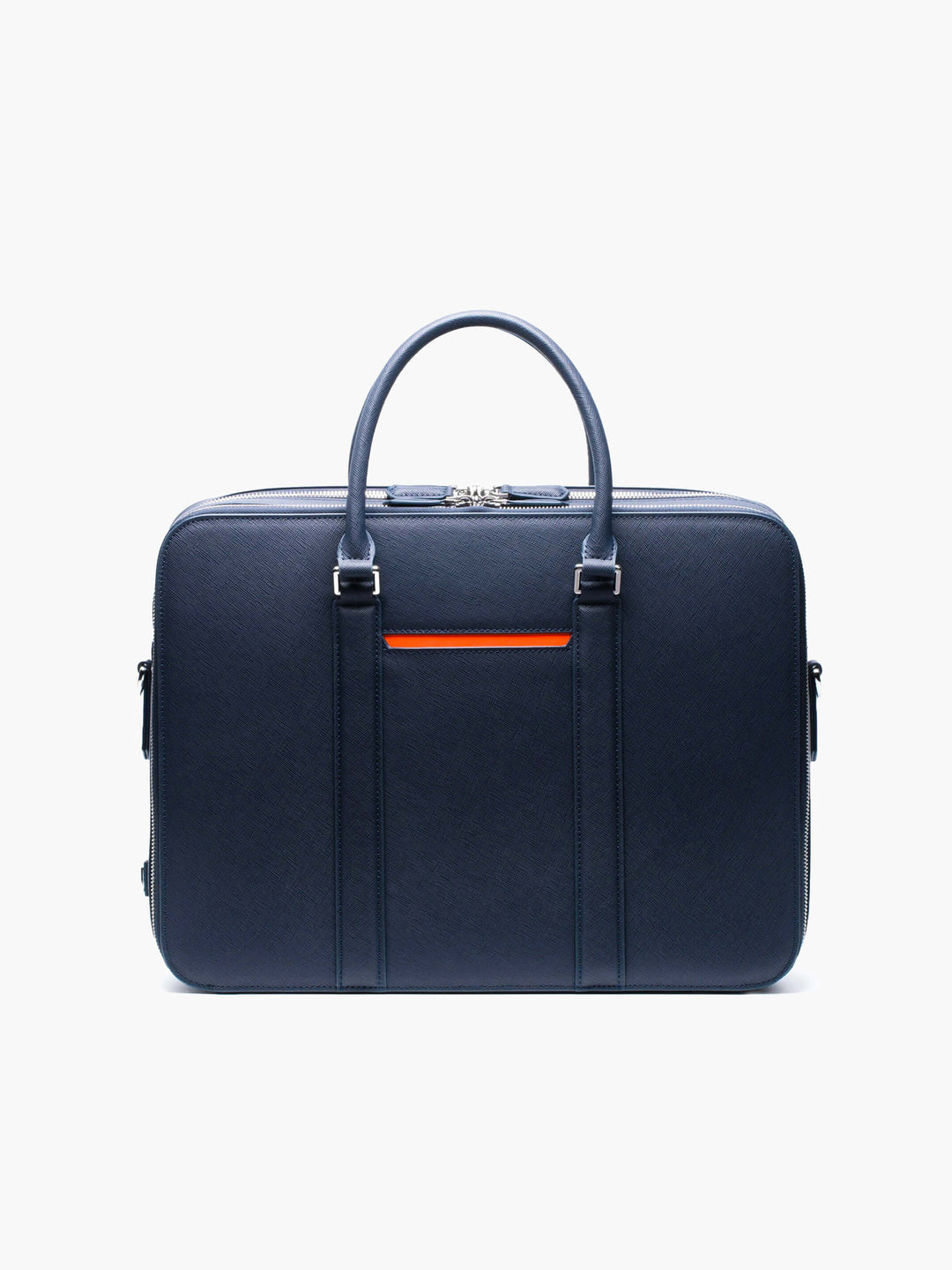
The Manhattan Leather Briefcase is the reference point: genuine Saffiano leather, 4.1 L in a 6.5 cm-deep profile, 1.2 kg, with a padded compartment for a 16-inch MacBook Pro. If you need more room in that class of material, the Windsor Deluxe Leather Briefcase runs 9.8 L in top-grain cowhide at 1.1 kg.
The honest summary: the biggest quality jump happens between the first and second step, where structure and lining appear. The third step buys material and finish.
How do you match a leather briefcase to the way you actually work?
Two people with identical budgets should often buy differently shaped bags, and format is where first-time buyers go wrong. Volume is the wrong starting question. Start with what leaves the house with you every day, then pick the format that carries that load without slack.
A slim single-compartment briefcase, roughly 4 to 7 litres and under 8 cm deep, suits the professional whose day is a laptop, a notebook and a phone. Picture a junior banker moving between floors and taxis: the bag stays flat under an arm and never invites the extra weight that fills a larger bag by default. A double-zip briefcase in the 10 to 12 litre range suits the consultant whose Tuesday involves a laptop, printed decks, a keyboard and a spare shirt. Two compartments mean client-facing paper never shares space with charger bricks, and you can open one side in a meeting without displaying the other.
A softer, unstructured messenger reads as more relaxed and works in creative and tech environments, though it protects a laptop less well unless the sleeve is genuinely padded. And if your commute involves a bicycle, a long walk or a packed train, be honest about it: forty minutes a day on one shoulder is a physiotherapy appointment waiting to happen, so look for a wide padded strap. Gear guides sort briefcase recommendations by profession for this reason - the format that serves a litigator does not serve a product designer.
Which leather bag tier fits your career stage right now?
If you graduated this year into an analyst or associate seat, buy at the first or second step. Your bag will spend its first year shoved under hot desks and thrown into overhead bins. Marcus, starting a Big Four graduate programme, needs a padded laptop slot, a wipe-clean shell and a luggage sleeve far more than he needs a hide that patinas. The Motion Light Briefcase 14" answers that precisely: 10 L, 0.9 kg, waterproof nylon with recycled vegan leather trim, a padded 14-inch laptop slot, three card slots and a luggage sleeve.
One to three years in and sitting in front of clients regularly, the middle step earns its money. This is where a bag that holds its shape stops being cosmetic, because you carry documents that cannot arrive creased. The Axis Leather Briefcase covers it at 11.2 L and 1.24 kg, with two front pockets and a detachable padded strap for days that involve both a laptop and a printer's worth of paper.
With a promotion or a client-facing title, buy at the third step once and stop thinking about bags. Genuine Saffiano at 1.2 kg in the 6.5 cm profile of the Manhattan Leather Briefcase is the version you keep. Buying here before you need it is the one mistake worth naming: an unstructured first year is hard on a good hide, and the bag looks better arriving after the desk-shoving phase.
What should you check before buying a leather bag under $400?
Run this list before you pay, in a shop or on a product page at 11pm. Each check takes a minute, and each has cost someone money to learn.
- Confirm the stated laptop fit in inches, not the litre volume. A 16-inch MacBook Pro needs a compartment built for it; a 14-inch slot will not stretch. - Weigh the empty bag. Much over 1.5 kg empty is weight you carry daily before your laptop goes in. - Read the material line in full. "Leather trim" means the body is something else, which may be exactly what you want, but know it first. - Look for a laptop compartment described as padded. A slip pocket sized for a laptop is not protection. - Check for a suitcase or trolley sleeve if you travel at all. Retrofitting one is impossible. - Check the strap: detachable is more versatile, a shoulder pad matters on a long walk, and anchor points should be reinforced rather than stitched alone. - Confirm the lining. A woven or recycled polyester lining survives pen leaks; a glued lining does not. - Check the warranty term and whether there is a trial window. A brand standing behind its stitching for years is telling you about the stitching. - Test whether the bag stands up empty.
If a listing will not tell you the lining, the laptop fit or the empty weight, treat the omission as the answer. Editorial reviewers publish those numbers because buyers use them; a brand withholding them has made a decision too.
Making the call on your leather bag under $400
Here is the decision, stripped bare. Spend at the first step if your commute is rough and your work is mostly digital, at the second if you carry paper and want a bag that holds its shape, and at the third if you are in front of clients and want a hide you will still like in five years. All three are correct answers, and each will outperform an expensive bag chosen for the wrong load.
If you take one thing from the price tiers: never buy the material without checking the construction. A Saffiano bag with loose stitching at the strap ring is a worse purchase than a well-built recycled-leather one, and you can now tell the difference from a cut edge and a stress point.
When you are ready to compare specifics, our briefcases list the numbers this guide told you to look for: laptop fit in inches, empty weight, litre volume, lining and trolley sleeve. For the shortest route through the range, compare the Delta Leather Briefcase at the mid step, 6.4 L and 1.06 kg in 100% recycled leather, against the Manhattan Leather Briefcase in genuine Saffiano at 4.1 L and 1.2 kg. Read the spec lines and buy the one that matches your Tuesday, not your ambition.
| Price step | Leather / body material | Hardware & zips | Lining | Stitching & edge finishing | Realistic longevity | Best fit for |
|---|---|---|---|---|---|---|
| Under $200 | Coated or high-performance vegan leather, or a technical nylon body with leather or vegan leather trim at corners and handles | Nylon or coated zips, often one-way; minimal metal | Recycled polyester or basic woven lining on better examples; glued lining on the weakest | Machine stitching at moderate density; folded or taped edges rather than burnished hide edges | 2-4 years of daily carry; surface wears rather than patinas | Graduates and first-job commuters with a rough commute and a mostly digital load |
| $200-$300 | Recycled leather or structured high-performance leather, usually with matching trim | Matte metal or gunmetal zips, mostly two-way; metal strap hardware | Full woven recycled polyester lining across compartments | Denser stitching with reinforcement at strap and handle anchors; sealed edges | 4-7 years; holds its structure, which is what usually fails first at this level | Years 1-3 in a client-facing role, carrying laptop plus paper plus tech |
| $300-$400 | Genuine Saffiano or top-grain cowhide; the hide itself is where the money goes | Polished or matte metal hardware, two-way zips, padded detachable straps | Full recycled polyester lining with dedicated padded laptop and tablet compartments | Tight, even stitching, reinforced stress points, finished and sealed edges you can inspect at arm's length | 7-10 years or more with care; develops patina on unsealed grain | Client-facing professionals, promotions, and anyone who wants to buy once |
Frequently asked questions
Can you get a real leather briefcase for under $400?
Yes. Between $300 and $400 you can buy genuine Saffiano or top-grain cowhide with a full woven lining and reinforced stress points - the Manhattan Leather Briefcase, for example, is genuine Saffiano at 4.1 L and 1.2 kg. Below $200 the body is usually coated or high-performance vegan leather with leather trim, which is a different product rather than a fake one.
How long should a leather work bag last with daily use?
A coated or vegan leather body with leather trim typically gives two to four years of daily carry. Recycled or structured leather at $200 to $300 runs four to seven years, usually failing at structure rather than surface. Genuine Saffiano or top-grain cowhide at $300 to $400 lasts seven to ten years or more with occasional conditioning and a dry storage spot.
Will a slim briefcase fit a 16-inch laptop?
Some will, but check the stated inch rating rather than the litre volume. The Manhattan Leather Briefcase holds a 16-inch MacBook Pro inside a 6.5 cm-deep profile, while the Motion Light Briefcase 14" is built around a padded 14-inch slot. A 14-inch compartment will not stretch to a 16-inch machine, and a slip pocket sized for a laptop is not padding.
Is a leather briefcase a bad idea if I commute in the rain?
If your commute regularly involves rain, bikes or long walks, buy a coated or waterproof body and keep leather as trim. The Vista Waterproof Briefcase carries 8.8 L around a padded 16-inch laptop slot at 0.81 kg empty. Unsealed hides mark when wet; Saffiano's sealed cross-hatch finish wipes clean but still prefers a dry commute.
What is the difference between Saffiano and top-grain leather?
Saffiano is a finish, not a grade: a cross-hatch texture pressed into the leather and sealed, which resists scratches and wipes clean. Top-grain describes the hide itself, the upper layer lightly sanded and refinished. Sealed Saffiano stays looking new for longer, while unsealed top-grain - as on the 9.8 L Windsor Deluxe Leather Briefcase at 1.1 kg - develops patina instead.