



Updated 2026-08-20
Backpack with a trolley sleeve: the short answer
A backpack with a trolley sleeve has an open-ended panel across its back that slides over a rolling suitcase's extended handle, so the bag rides flush on the case instead of hanging off your shoulder. Before buying any work bag, check three things: handle stitching at its base, strap padding and clip strength, and sleeve depth.
Why do handles, straps and trolley sleeves decide how your workday feels?
Think about the last bag that annoyed you. It was almost never the leather. It was the handle that pressed a red line into your palm on the walk from the car park, or the bag that toppled off your suitcase at the gate because the sleeve on its back turned out to be a decorative flap. Carry hardware is the part of a bag that touches your body, and the part product pages describe with the least precision. Gear Patrol's working definition of a good briefcase starts in the same place: lightweight, a comfortable handle, room for a computer and documents, and materials built to last.
Take Elena, an operations director who drives twenty minutes, parks, then walks eleven minutes to her building. That is roughly ninety minutes a week with a loaded bag hanging off four fingers. A handle of raw webbing and one rolled and stitched through a reinforced base look identical in a photograph and feel nothing alike by Thursday.
The bag also travels further than it used to. Stanford's Global Survey of Working Arrangements, covering more than 16,000 graduates across 40 countries, found workers at home an average of 1.27 days a week, with 80 percent of Fortune 500 companies running hybrid schedules of about three days in the office and two at home. More doors, more platforms, more suitcase handles. Hardware is where the mileage shows first.

What makes a briefcase or backpack handle last, and what fails first?
A handle lasts when the load path is continuous: the handle wraps a core, the core anchors into a reinforced patch of the bag body, and the stitching joining them is dense, doubled and backed by a hidden layer rather than sewn through a single ply of leather. Almost every handle failure happens at that last point.
Rolled or wrapped handles spread pressure across the fingers because the cross-section is round rather than flat, which is why a good one still feels fine at minute ten. Raw webbing or a thin folded strip concentrates the load on a narrow edge, and your palm knows within a block. Handle drop is the third variable and nobody mentions it: the vertical gap between the top of the bag and the underside of the handle. Around 9 to 12 cm lets a hand pass through cleanly without the bag swinging into your shin.


A ten-second thumb test at the handle root
Count stitches where the handle meets the body. A dense, even line with backstitching at both ends shares the tug across many holes; a sparse line of long stitches is a row of perforations waiting to become a tear. Tomas, a litigation associate carrying two case files and a 16-inch laptop, lost a handle eight months in. The leather was fine. The stitch line at the left root gave up one stitch at a time until the anchor tore free on a station platform. Put your thumb under the handle root and pull up: if the leather puckers or the panel lifts away, the reinforcement behind it is thin.
What should you check on a shoulder strap before you buy a backpack or briefcase?
Three things decide whether a shoulder strap is still comfortable at 6pm: how wide and dense the pad is, how it attaches to the bag, and whether you can take it off. Everything else is trim.
Start with width. Carryology's guidance is that wider straps spread the load better across the shoulder, but go too wide and they rub the neck and arms, so the answer is a compromise rather than a maximum. Thicker foam suits heavier loads, and the edges have to be soft or they will irritate you as you walk. Early straps were straight, unpadded canvas or leather, which limited comfort, fit and weight distribution. The curved and S-shaped straps that replaced them exist because a flat band does not sit naturally around the neck, chest and sides.
Where strap hardware quietly gets cheap
Cast hardware has weight in the hand and a gate that closes with no side-to-side play. A stamped hook folded from sheet metal flexes when you squeeze it, and that is the one that opens under lateral load when the bag swings into a turnstile, usually inside the first year. A swivel snap hook that rotates freely lets the strap follow your body as you turn. Nadia, a sales director, walks eighteen minutes from the station to a client's office twice a week with a laptop, a bottle and printed decks. On the bag she chose the strap detaches: off for taxi-to-lobby days, back on for the walk.

What is a trolley sleeve on a backpack, and who actually needs one?
A trolley sleeve is an open-ended fabric panel stitched across the back of a bag that slides down over the extended handle of a rolling suitcase, so the bag rides on the case and travels with it instead of on you. A backpack with a trolley sleeve does the same job as a briefcase with one: it turns two bags into a single wheeled unit through an airport or a station concourse.
Who needs one? Frequent fliers first, since a docked bag frees a hand for a boarding pass. Then commuters who wheel a case on client days, and hybrid workers moving between home, office and co-working space.
Pass-through sleeve or shallow luggage loop?
There is a real difference between the two, and product photography hides it. If a listing says 'luggage strap' rather than sleeve, assume the shallow version until you see the back panel. A pass-through runs the full depth of the back panel, open top and bottom, so both bars of the suitcase handle sit inside it and the bag is held at two points. It cannot rotate. A shallow loop is a short strip sewn across the middle of the panel, sometimes wide enough for one bar only, so the bag hangs from a single contact point, pivots on corners and slides sideways on escalators. Depth is the other measurement: the sleeve needs enough vertical run to keep the bag below the case's centre of gravity, and enough width to accept a two-bar handle set roughly 8 to 12 cm apart.

The trade-off a trolley sleeve brings
A sleeve needs a stiffened back panel to stay flat rather than collapse. That helps the bag hold its shape when you set it down, but it sits firmer against your body and adds weight. If you never travel with wheels, you are paying in rigidity for a feature you will not use.
Top handle, shoulder strap or trolley sleeve: how do the three carry modes compare?
Most bags on your shortlist fall into one of three carry configurations, and distance decides which is right. A top handle alone is the purist's option and it is genuinely fine, as long as you never walk far. Add a shoulder strap and you buy back distance, because the load moves off your fingers and onto your torso. Add a trolley sleeve and you buy back travel days, because the bag stops being something you carry at all.
The table below compares the three on the criteria that matter when you have two tabs open and are trying to choose.
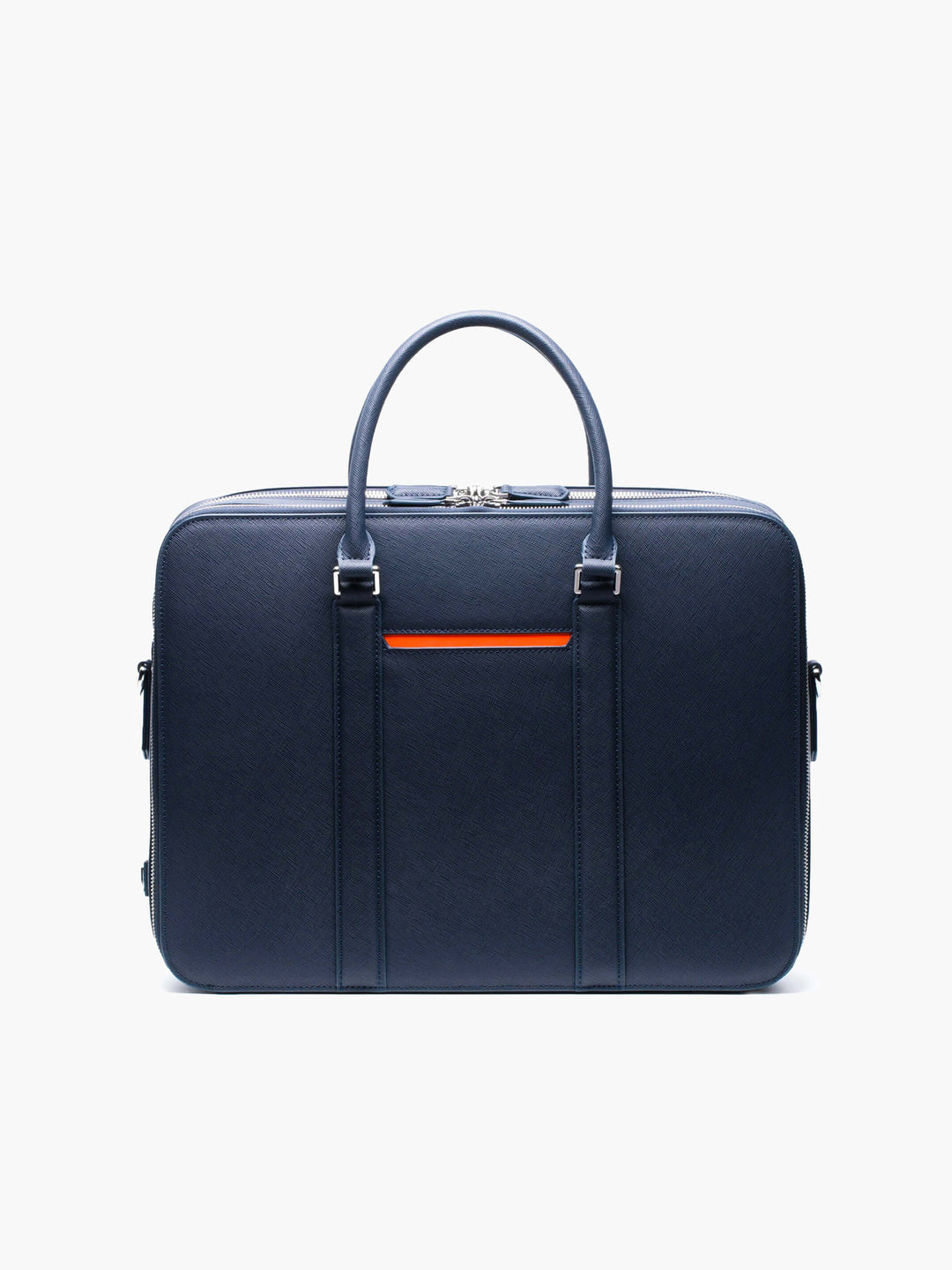
Then check the configuration is executed rather than merely listed. As a three-mode example, the Axis Leather Briefcase carries 11.8 L, fits up to a 16-inch MacBook Pro, and pairs reinforced top handles with a detachable shoulder strap and a luggage trolley sleeve in water-resistant microfibre vegan leather. That is the whole checklist in one bag: a handle built at the stress point, a strap you can remove, a sleeve rather than a loop.
The same test applies to a trolley sleeve tote, with one caveat. A tote's open top puts more load on the handles than a structured briefcase does, so wrapped handles matter more, not less. Marcus, a brand director, chose a three-mode bag for one reason: in the fortnight he pitches, the bag rides the suitcase, and the rest of the month the strap stays in a drawer.

Where does a cheap backpack with a trolley sleeve fail first?
Cheap bags do not fail randomly. They fail in a predictable order, and once you know the order you can assess any bag in ninety seconds. Use it on us, on the brand beside us, and on the bag you already own.
Check one is handle stitching density. Count stitches over a centimetre where the handle meets the body: dense and even with backstitching at each end means the load is shared, while long, loose stitches mean the panel is perforated more than joined. Check two is hardware plating. Run a thumbnail along the underside of a buckle, because thin plating over soft base metal flakes to grey after a year of keys and coins, while solid hardware keeps its colour on the hidden faces too. Check three is the clip gate: squeeze it sideways rather than opening it the intended way, because flex means stamped sheet metal, the most common strap failure there is. Check four is sleeve depth. Push four fingers into the trolley sleeve and see whether they disappear to the knuckle; an opening that takes only a fingertip will not hold a two-bar handle. Check five is where nobody looks, the base corners under the lining, where the bottom panel meets the sides and the laptop's weight lands each time you set the bag down. You want doubled stitching and a bound seam there, because a single row through unbound edges frays silently until the day something drops through.
Priya, a finance director, ran this sequence across three shortlisted bags in a store and eliminated two before opening a main compartment: one had a fingertip-deep sleeve, the other a strap hook that flexed under a light squeeze.
Backpack with a trolley sleeve or briefcase: which matches your working week?
More carry modes is not better. The right configuration matches the shape of your week, and a backpack with a trolley sleeve is only the right answer for some of those weeks.
Office-anchored weeks: trust the handle, add the strap
If you commute by car or train to the same building most days, you need a handle you trust and a strap you can add for the walk from the station. The Manhattan Leather Briefcase suits that week: 1.2 kg, 8 L, 42 x 30.5 x 9 cm, a padded compartment for a 16-inch MacBook Pro, and a detachable shoulder strap in scratch-resistant Saffiano leather.

Weekly fliers: the trolley sleeve is the whole point
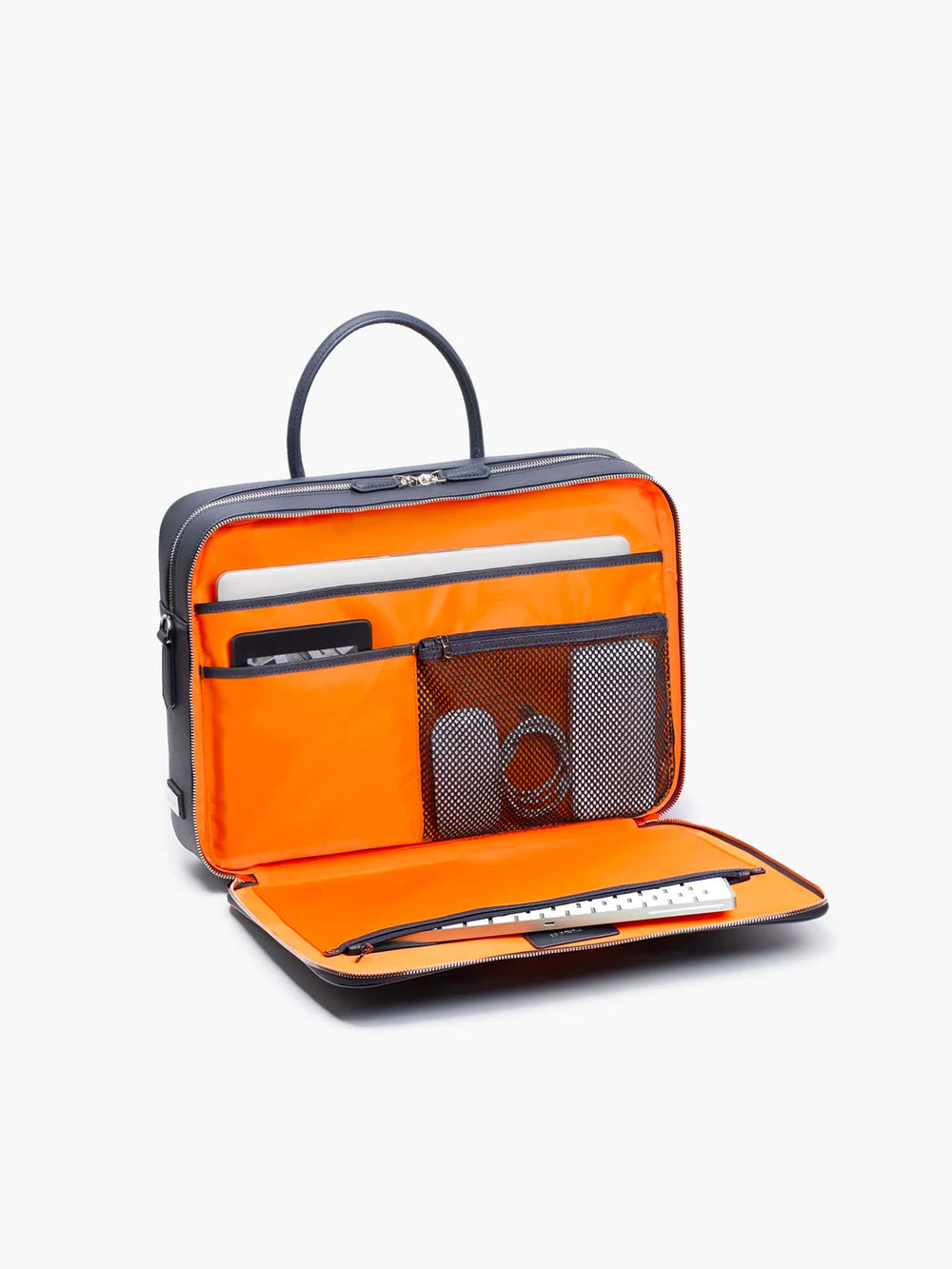
Daniel, a strategy consultant on Monday-out, Thursday-back rotations, crosses more terminals than desks in a week. The Mercator Double-Zip Leather Briefcase holds 10.5 L across two main compartments at 1.12 kg and 40 x 29 x 9 cm, with a detachable shoulder strap and a luggage sleeve that fits the Mercator Carry-On Suitcase and most standard handles. If he wants both shoulders free in a security queue, the Mercator Leather Backpack is the same system in pack form: 19 L, 1.12 kg, 44 x 30 x 14.5 cm, docking to the same 34 L carry-on.

Hybrid weeks: a light backpack with a trolley sleeve
If you split the week between home, a co-working space and client sites, the constraint changes. You are rarely beside a suitcase, but the bag goes on your back many times a day, so weight decides how the week feels. Gear Patrol's case for the everyday pack applies here: a backpack balances weight better than a crossbody and carries more than a tote. The Explorer Light Backpack weighs 0.86 kg empty, carries 16.9 L in a 40.5 x 29 x 13.5 cm frame, protects a 16-inch MacBook Pro in a padded compartment, and still has a trolley sleeve for the client visit that turns into an overnight.


Before you commit: your five-point carry audit
Five questions for anything on your shortlist. Load the bag first, because an empty one tells you nothing: laptop, charger, notebook and a full bottle is a fair working weight.
Can you hold the handle for ten minutes without discomfort? Not ten seconds in a showroom. Load it, hold it, walk. A hot spot in the palm at minute three becomes a grievance by month three.
Does the shoulder strap clip feel solid under lateral pressure? Push the hook sideways against the D-ring, the way it moves when the bag swings into a barrier. Flex in the gate, or rattle in the swivel, is your answer.
Does the trolley sleeve hold the bag flush and centred? Slide it onto a case, push forward, stop hard. The bag should stay square rather than pivot, and sit low against the case rather than perched on top.
Is the base stitching double-reinforced? Look inside at the bottom corners for two rows and bound seams. That is what carries the laptop every time you set the bag on a hard floor.
Does it pass the drop test? Set the loaded bag down, then lift it briskly by the handle alone. It should come up square, with no buckling where the handle meets the body.
Any bag that answers all five is worth your money, whoever made it. Every Maverick & Co. product page lists weight, capacity, dimensions and laptop fit in full, so you can run most of this audit before the bag reaches your hand.
| Carry configuration | Best use case | Comfort over distance | Travel compatibility | Structure added to the bag | Typical build-quality signal |
|---|---|---|---|---|---|
| Top handle only | Short walks: car to lobby, desk to meeting room, taxi to client office | Good for under five minutes, then the load concentrates in four fingers | Low. Nothing to dock to a suitcase, so it rides on your hand or sits on the case unsecured | Minimal. The bag stays soft and slim, and packs flat in a carry-on | Handle root reinforcement is the only load-bearing joint, so it is where the whole bag is judged |
| Top handle + shoulder strap | Station-to-office commutes, walking city blocks, anyone carrying a laptop plus documents | Strong. Weight moves off the fingers and onto the torso, so twenty minutes stays comfortable | Moderate. Hands-free through a terminal, but the bag still swings while you wheel a case | Low to moderate. Needs anchored D-rings or attachment points on the body panel | Cast swivel hooks with no gate flex, and a removable strap rather than a sewn-in one |
| Top handle + shoulder strap + trolley sleeve | Weekly fliers, client-site travel, anyone pairing a work bag with rolling luggage | Strong, and on travel days the bag is not carried at all | High. Docks flush to a suitcase handle so both hands stay free | Highest. A stiffened back panel keeps the sleeve flat and the bag holds its shape when set down | A full-depth pass-through that takes both handle bars, not a shallow single-bar loop |
Frequently asked questions
Will a backpack with a trolley sleeve fit any suitcase?
Most, but not all. A full-depth pass-through sleeve accepts a two-bar telescopic handle with the bars set roughly 8 to 12 cm apart, which covers the majority of carry-on cases. Single-bar handles and unusually wide bar sets are where fit fails. Check the sleeve is open at both top and bottom rather than a short loop sewn across the middle of the back panel.
How deep should a trolley sleeve be?
Deep enough that four fingers disappear to the knuckle when you push them in, and long enough to run the full height of the back panel. A shallow sleeve lets the bag ride above the suitcase's centre of gravity, so it pivots on corners and slides sideways on escalators. A full-depth sleeve holds the bag at two points and keeps it square.
Can you add a trolley sleeve to a backpack that does not have one?
Aftermarket luggage straps exist and they clip around the suitcase handle, but they hold the bag at one point rather than two, so it rotates whenever you turn. They also cannot supply the stiffened back panel a built-in sleeve relies on to stay flat. If you fly more than a few times a year, buy the sleeve built in.
Does a trolley sleeve make a backpack less comfortable to wear?
Slightly firmer, yes. The sleeve needs a stiffened back panel to stay flat, which adds a little weight and sits less softly against your spine than an unstructured pack. In exchange, the bag holds its shape when set down and protects a laptop better. If you never travel with wheeled luggage, you can skip the feature.
Is a briefcase or a backpack better for frequent flying?
Either works if it docks to your case. A briefcase with a luggage sleeve slides under a seat easily and reads better in a client meeting. A backpack keeps both hands free in a security queue and balances weight better on long terminal walks. Choose by how much of the trip you spend walking, not by how the bag photographs.