



Updated 2026-09-23
Why does bag format decide how your short business trip goes?
The best backpack for short business trips is a carry-on of roughly 17 to 22 litres that takes a 16-inch laptop plus one or two days of clothes. Choose a duffel when you need more soft capacity, and a rolling carry-on only when you stay in one hotel rather than moving between meetings.
Format sets the friction level of the whole trip. It decides how fast you clear security, whether you can walk into a meeting straight from the gate, and how much of your attention the bag takes up in between. Packing well inside the wrong format still leaves you fighting the format.
There is a lot of this travel about. Global business travel spending was projected to reach a record $1.57 trillion in 2025, a 6.6% rise year on year, and is forecast to pass $2 trillion by 2029, according to GBTA. Most of that is not the two-week tour. It is the short, dense, in-and-out trip, repeated.
Take Daniel, a regional sales director who flies Manchester to Dublin on the 07:10, takes a client meeting at 11:00, a site visit at 14:00, and is home by nine. He owns an excellent rolling carry-on. On this trip it is the wrong object: it clatters across a cobbled square between appointments, it has to be parked somewhere over lunch, and it turns a five-minute walk into a negotiation with kerbs. Nothing is wrong with the bag. The format does not fit the shape of his day.
So start one step earlier than most buying guides do. Describe the trip, then pick the format that suits it, and only then compare individual bags.
Which short business trip are you actually packing for?
Almost every short business trip falls into one of three profiles, and each asks something different of your bag. Name yours and the format question gets much smaller.
The pattern behind all three is face-to-face demand. One survey of 1,200 business leaders found 81% said holding more meetings would help them in some way, and 66% of meeting-planning professionals expect meeting spending to grow. More meetings means more short trips, and short trips are exactly where format errors hurt most.

Profile one: the one-night business trip
Sophie, a fintech COO, flies London to Amsterdam on a Tuesday evening, presents at nine the next morning, and is back for dinner. She carries a laptop, a change of shirt and a washbag. Nothing else. Her bag spends most of its life on her shoulder in transit, then sits beside her in a boardroom, which means it has to look like it belongs there. Capacity is not her problem. Arriving without looking like she came off a flight is.


Profile two: the two-day regional business trip
Marcus runs a specialist manufacturing account and moves between three client sites over two days, part drive, part flight. He needs two days of clothes, a laptop, a folder of printed drawings, trainers for the early gym slot, and both hands free for carrying samples across a factory floor. Volume matters here, but not as much as keeping gym kit away from shirts and keeping his palms empty.

Profile three: the three-day, single-hotel trip
Elena, a strategy consultant, checks into one hotel on Tuesday and works from the client's office and a coworking space until Thursday. The bag she flies with is not the bag she carries during the day, and her clothes never leave the room after check-in. She needs a base and a day carry, which is why one bag rarely satisfies this profile no matter how cleverly it is organised.


What should a business trip backpack do without being asked?
Before you compare formats, agree on the baseline. These are the jobs a business trip backpack, duffel or rolling case should handle so automatically that you never notice them.
First, the laptop has to come out with one hand. Carryology's business travel picks favour bags with top and side access so you can reach a laptop on the move, which is the difference between a smooth security lane and unpacking everything onto a steel table. Second, the bag must stand up on its own when you set it down. A bag that slumps spills, and a bag that spills at a client's reception desk costs you the first ninety seconds of the meeting. Third, it needs a trolley passthrough sleeve. Carryology notes that the passthrough is what lets a bag work as one half of a pair with rolling luggage, and that pairing is how most experienced travellers actually move.
After that: weather resistance that survives a taxi rank in the rain, an empty weight you would accept before anything goes in, and enough defined pockets that you stop rummaging. Ask one blunt question of any bag you are considering. Where does the charger live? If you cannot answer instantly, the interior is not sorted enough for a trip where you will open the bag fifteen times a day.
Clear all six and it is a candidate. Fail two and it will irritate you on every trip you take with it.

Backpack vs duffel vs rolling carry-on: which format wins?
The short version: the backpack wins on mobility, the duffel wins on soft capacity, and the rolling carry-on wins on load relief over distance. The comparison table sets out trip length, carry-on compliance, laptop access, meeting readiness and mobility for each format.
Why a backpack wins most short business trips
The backpack is the default for one and two-night trips because it keeps both hands free and both shoulders loaded. The Maximus Travel Backpack shows what the format holds when it is built for work rather than weekends: 22 L across 44 x 31 x 16 cm, 1.16 kg empty, and a clamshell tech compartment that opens flat for a 16-inch MacBook Pro. It stands upright empty or full, so it does not collapse when you set it beside your chair, and five exterior pockets mean the passport and boarding pass never migrate into the main compartment.
When a duffel beats a business backpack
The duffel trades hands-free carry for volume and packing speed. The Motion Work-to-Weekend Duffel runs 27 L with expandable volume at 1.25 kg, and the detail that matters for work is the front office compartment with a padded slot sized for a 16-inch laptop and A4 documents, which keeps your machine off the bottom of the bag where the shoes are. A luggage sleeve on the back lets it ride on a rolling case when the trip extends past two nights.


When wheels beat a backpack on a business trip
The rolling carry-on takes the weight off you entirely. The Mercator Carry-On Suitcase holds 34 L at 55 x 36 x 23 cm, weighs 3.77 kg, and carries two large front slots for documents and a 16-inch MacBook Pro, so the laptop comes out at the gate without opening the main clamshell. Note the trade: 3.77 kg of your allowance is the bag itself, and wheels are a liability on stairs and cobbles.
When Marcus compared all three for his two-day site tour, the duffel won on volume and lost on the factory floor, where he needed both hands. That is how format decisions usually resolve. Not on capacity, but on what you are doing between the airport and the hotel.
Which backpack suits your short business trip profile?
Now put the two halves together. Each profile has a format that fits it cleanly, and a specific reason why.
One-night business trip: choose a convertible backpack. Priya's problem is not capacity, it is arriving at a nine o'clock presentation looking like she came from her own office. The Nexus Convertible 3-Way Backpack answers that directly at 17 L and 1 kg, with an individual laptop compartment for a 16-inch MacBook Pro and concealable backpack straps with two easy-switch handles. It rides on her back through the terminal and goes into the room as a briefcase. One bag, two identities, no changing act in the lobby.
Two-day regional visit: choose a full-size business backpack. Marcus needs hands free and his trainers nowhere near his shirts. The ProActive Waterproof Business Backpack carries 19.6 L at 0.98 kg with a detachable shoe bag and two padded laptop compartments for a 16-inch MacBook Pro, so the gym kit is quarantined and the client's drawings are not creased underneath it. Under a kilo empty matters when you are on your feet across three sites.
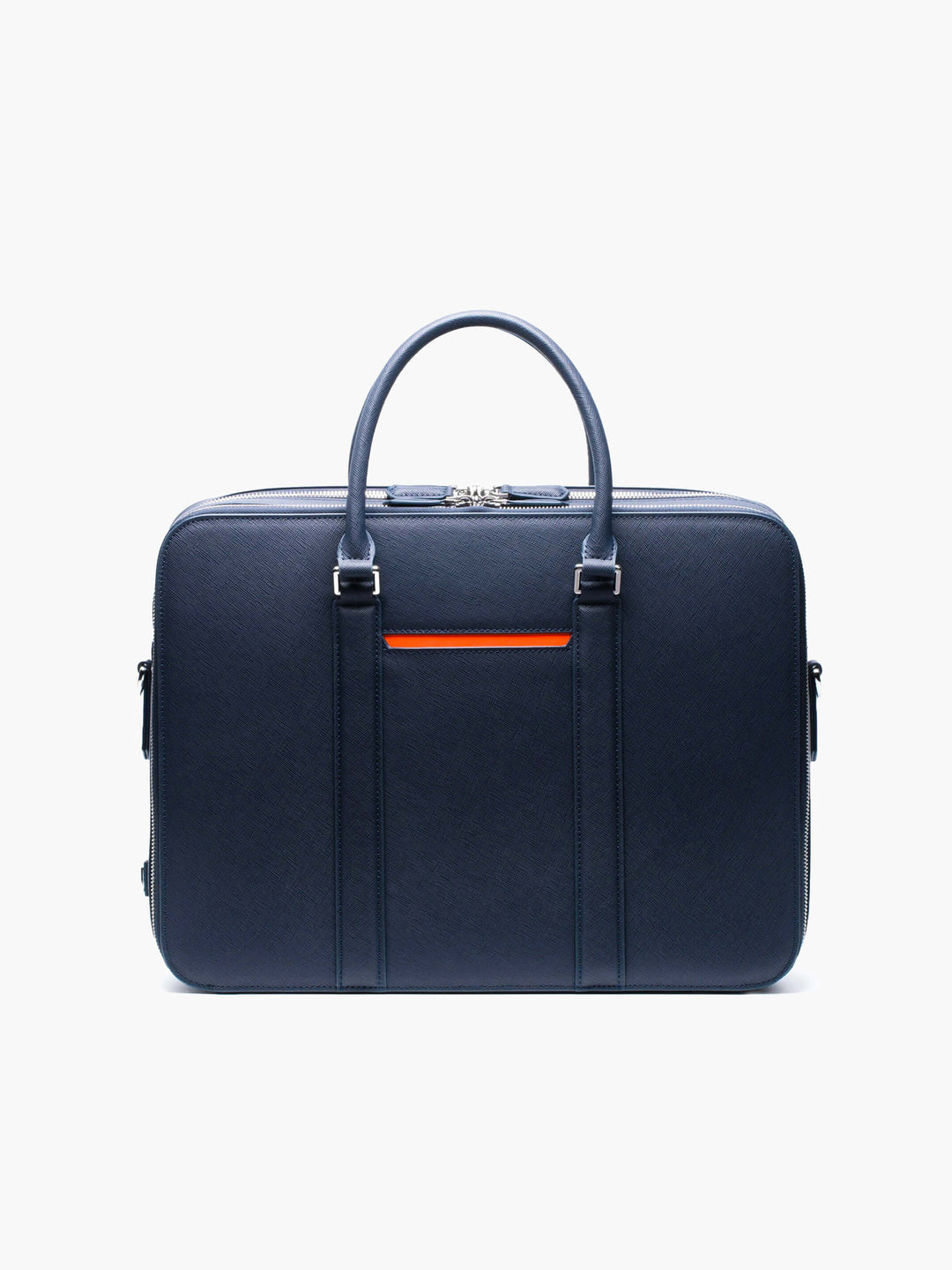
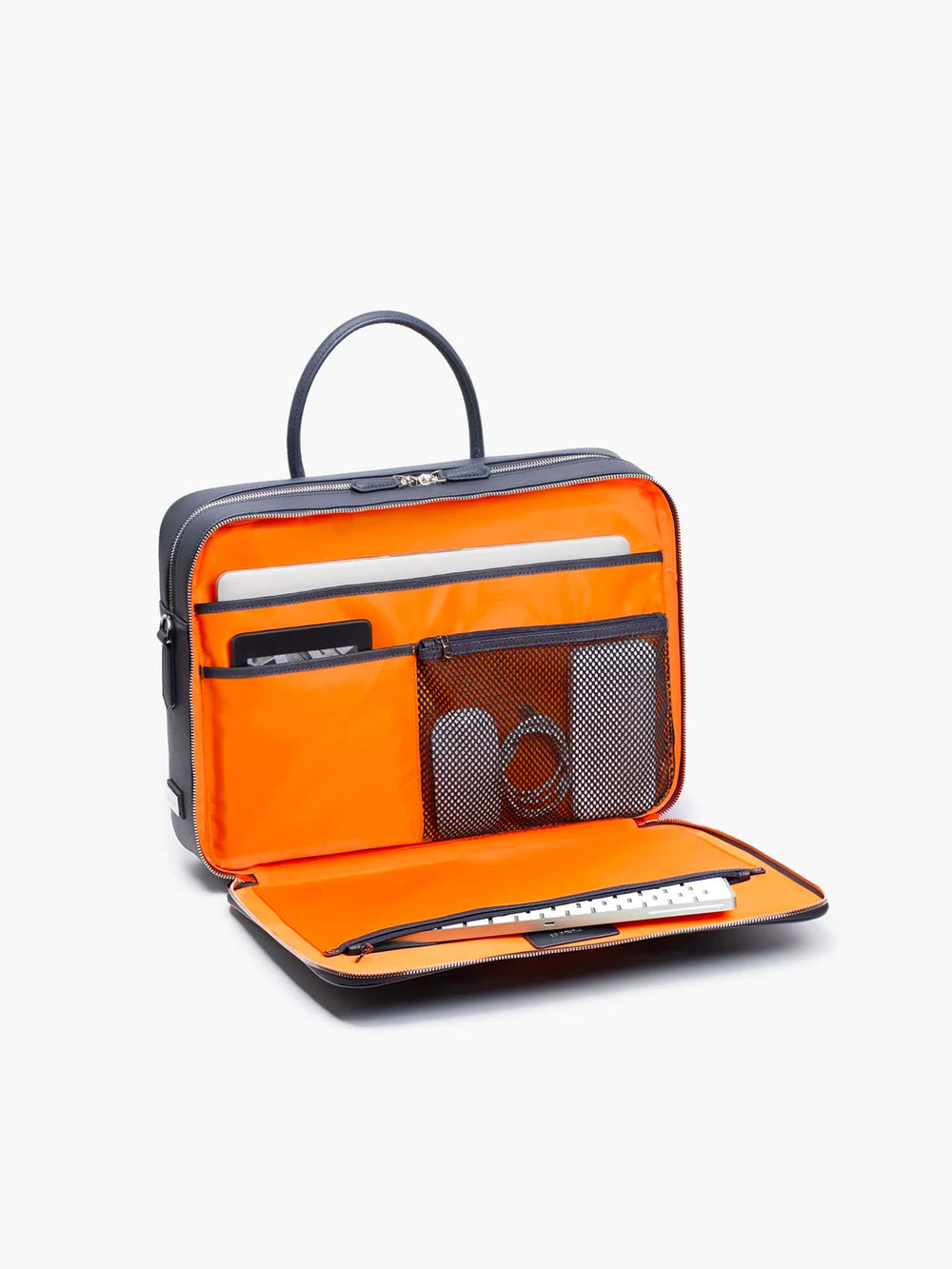
Three-day single-hotel trip: choose a rolling case plus a day bag. Elena's clothes never leave the room, so she should not be carrying them around Zurich. The Mercator Carry-On Suitcase holds the wardrobe, and the Mercator Double-Zip Leather Briefcase does the working hours at 10.5 L and 1.12 kg across two main compartments. It rides with the case through the airport, then detaches for the walk to the client's office.
If your trips cross profiles, buy for the one you take most often and let the other two borrow the bag. That is cheaper and simpler than owning three compromises.
Which backpack mistakes slow you down at the airport?
Some choices cost you time and credibility on every trip. They are easy to spot once you know the pattern.
The oversized pack is the most common. Tom took a 40-litre travel pack on a one-night trip to Frankfurt because it was the bag he owned. It met carry-on rules, but it filled the overhead bin, it came off his shoulders in every crowded corridor, and the empty space let two shirts and a charger roam free inside it. Capacity you do not use is not free. It is bulk you carry.
The single-compartment duffel is the second. Sofia's gym bag put her laptop under her shoes and left her kneeling on the floor at security, digging it out with a queue building behind her. Any bag going through an airport needs a dedicated, externally accessible laptop slot. No exceptions.
The third is the bag that reads as sports kit in a boardroom. Logos and dangling straps are fine on a Saturday and distracting when you are presenting. The fourth is the bag with no trolley sleeve, which stays on your shoulder while your other hand tows the case, and grows heavier with every terminal.
One question strips out most bad options. Would you be comfortable walking into the most important meeting of your quarter with this bag, straight off a flight, without putting it down first?
How do you size a backpack for a short business trip?
Size the bag against your real kit, not against a number on a product page. It takes about ten minutes and it prevents the most expensive mistake in this category, which is buying a format that does not match the volume you actually carry.
Start by laying out everything you took on your last short trip. Laptop, charger, changes of clothes, washbag, documents. Ade, a design consultant who travels twice a month, did this on his bed and found his real load was one suit change, a 16-inch laptop and a washbag. Roughly 15 to 18 litres. He had been shopping for 30-litre bags.
Then apply three checks. One, count the nights and allow about 7 to 8 litres per day of clothing for business dress, which puts a one-nighter comfortably inside 20 litres and a two-day trip closer to 25. Two, confirm the dimensions against the published carry-on and personal-item limits of the airline you fly most, which carriers such as American Airlines list on their baggage pages. Three, weigh the bag empty. Anything over about 1.3 kg for a soft bag is weight you are paying for before you pack.
Finally, run the stair test in your head. Picture yourself carrying the loaded bag up two flights at a train station, then walking straight into a meeting. If that image makes you wince, you are looking at the wrong format rather than the wrong brand.
So what is the best backpack for short business trips?
The backpack wins the short business trip outright, and the exceptions are specific rather than vague. One or two nights, meetings between the airport and the hotel, no checked bag: that is backpack territory, and the Maximus Travel Backpack at 22 L and 1.16 kg, with a clamshell compartment for a 16-inch MacBook Pro, covers it without spilling into luggage.
Take the duffel when the volume is genuinely larger and you will not walk far with it. The Motion Work-to-Weekend Duffel gives you 27 L with expandable volume, 1.25 kg empty and a padded 16-inch laptop slot, which suits the two-day trip with a gym session and a dinner. Take the rolling carry-on when the trip runs three days or more, or when you are based in one hotel and the clothes can stay there. The Mercator Carry-On Suitcase holds 34 L at 55 x 36 x 23 cm and pairs with a briefcase or backpack, so the working kit rides on top and comes off in one movement.
One rule to carry away: the more moving you do between appointments, the more you should favour a bag on your back. The more time your clothes spend in one room, the more you should favour wheels.
Before your next trip, lay your kit out, measure what it comes to, and decide the format before you open a single product page. When you get to that stage, the Maverick & Co. range spans all three formats with capacity, empty weight and laptop fit listed on each one, so you can compare bags on the trip you actually take rather than the one the photography suggests.
| Bag format | Best trip length | Carry-on compliant | Laptop access | Meeting-ready | Mobility score |
|---|---|---|---|---|---|
| Business backpack | 1-2 nights | Yes, and usually fits as a personal item | Excellent - dedicated external laptop compartment | Good, if the styling is restrained | 5/5 - both hands free, stairs and cobbles are irrelevant |
| Convertible 3-way backpack | 1 night | Yes | Excellent - individual laptop compartment, reachable in either mode | Excellent - straps conceal, carries as a briefcase | 5/5 - switches carry mode without repacking |
| Work duffel | 2-3 nights | Yes, at typical 24-29 L sizes | Good, only if there is a separate padded slot | Moderate - reads casual unless structured | 3/5 - one shoulder loaded, tiring over distance |
| Rolling carry-on | 3+ nights, or single-hotel trips | Yes, at standard 55 x 36 x 23 cm | Good - best when front organisation opens separately | Moderate - needs parking during meetings | 2/5 - fast on smooth floors, slow on stairs and cobbles |
Frequently asked questions
How many litres do I need for a one-night business trip?
For a one-night business trip, 17 to 20 litres is usually enough: a 16-inch laptop, one shirt change, a washbag and a charger. Allow roughly 7 to 8 litres per day of business clothing, so a two-day trip sits closer to 25 litres. Anything above 30 litres on a one-nighter leaves contents loose and adds bulk you carry for nothing.
Does a business backpack count as a personal item on a flight?
Often yes, but the limit is set by the airline rather than the bag. Carriers publish their own carry-on and personal-item dimensions, as American Airlines does on its baggage page, so check before you fly. A 17 to 22 litre business backpack will typically fit under the seat in front of you, while a 30-litre travel pack usually needs the overhead bin.
Is a backpack acceptable to carry into a client meeting?
Yes, if the bag is structured and restrained enough to read as work luggage. A convertible like the Nexus Convertible 3-Way Backpack, 17 litres at 1 kg, conceals its straps and carries as a briefcase on two switch handles, so you arrive from the terminal without looking like you came from a gym. Loose straps, sports logos and bags that slump are what undermine it.
Backpack or rolling carry-on for a three-day trip?
Three days is the point where wheels start to pay. If you are based in one hotel and the clothes stay there, a rolling carry-on such as the Mercator Carry-On Suitcase, 34 litres at 55 x 36 x 23 cm, plus a slim day bag beats one overloaded backpack. If you are moving between cities and meetings each day, stay with the backpack.
How much should an empty travel backpack weigh?
Under 1.3 kg is a fair ceiling for a soft business backpack, because empty weight is allowance you spend before packing anything. The ProActive Waterproof Business Backpack is 0.98 kg for 19.6 litres, and the Maximus Travel Backpack is 1.16 kg for 22 litres. A rolling carry-on inverts the maths: the Mercator Carry-On Suitcase is 3.77 kg before you put a shirt in it.