



Updated 2026-09-03
Does briefcase colour actually change how professionals read you?
Yes, non-black briefcases are professionally acceptable. On briefcase colour, professionals now treat black, charcoal grey and dark brown as equally formal, with cognac and tan fine in most corporate offices and olive best kept for business-casual or creative settings. What decides formality is depth of tone and finish, not the colour name.
Your briefcase colour is read before your handshake, and it reads as a decision rather than a default. At six feet nobody can assess grain, stitch density or hardware. They see a shape and a tone, and the tone tells them whether you thought about it. Black is the safe answer, which is exactly why it says so little. A deep chocolate or a slate grey says you had options and made a call.
This matters more than it did fifteen years ago because the suit stopped doing the signalling. When Goldman Sachs moved to a firmwide flexible dress code in 2019, suits and ties became optional across the bank, and the rest of finance and professional services followed at their own pace. Take the jacket and tie out of the equation and the objects that remain carry more weight: the watch, the shoes, the bag you set down on the table.
Consider Logan, a tax partner who pitches four times a month to second-generation family businesses who dislike being sold to by people who look like a bank advert. He switched from black to dark brown and reports the same thing every time: the bag gets mentioned in the first two minutes, the conversation starts warmer, and nobody has ever asked whether it was appropriate. Compare Nadia, an eight-year associate whose black case sat in a row of eleven identical black cases outside a promotion panel. Neither outcome was decided by a bag. One owner got a small, cheap advantage; the other got nothing.
What briefcase colour rules do professionals follow in conservative offices?
Conservative offices do not ban brown. They penalise mismatch. The failure is almost never the colour of the hide; it is a bag sitting at a different formality level to the clothes around it, or a tone that fights the shoes and belt below it.
Three rules hold across law, finance, accountancy and government. First, depth beats hue: espresso brown or charcoal grey reads as formally as black, because formality in leather is a function of how dark and how uniform the surface is. Second, your bag should sit at or below the warmth of your shoes. A mid-brown case above oxblood or dark tan shoes reads as coordinated without an exact match, while black shoes with a tan case looks accidental. Third, your most formal day of the week sets the ceiling. If you appear in front of a regulator once a quarter, buy for that day.

Where the briefcase colour rules actually bend
The rules bend by room, not by industry. You will still hear the old line about no brown in town, and it survives as inherited habit rather than policy. Fortune's 2024 reporting on post-pandemic dress describes workplaces where fewer rules are written down and more are absorbed by watching. Elena, general counsel at a mid-cap insurer, carries a grey case daily and keeps nothing else in reserve, because grey clears both her board meetings and her Friday site visits. Her test is simple: if the bag would look unremarkable on the most senior person in the room, it is safe. That one question retires most of the anxiety here.


Black vs grey vs brown vs tan vs olive: which briefcase colour holds up where?
Ranked by formality, the order runs black, charcoal grey, espresso brown, mid-brown or cognac, tan, then olive. Everything from espresso upward is boardroom-safe without qualification. Cognac and tan are safe in most corporate offices and become a liability only in courtrooms, regulatory hearings and formal client dinners. Olive is a business-casual colour that behaves well in tech, architecture, media and consulting, and looks out of place at a magic-circle firm.
The practical distinction is what each colour asks of the rest of your wardrobe. Black and charcoal coordinate with anything, which suits people who own five suits in three shades of navy and grey and would rather not think about it. Brown and tan demand one decision: brown or oxblood shoes. Once that is settled, they carry a navy suit, a grey suit and a chino-and-blazer Friday equally well, which is a wider working range than black offers.
The table below sets the colours against each other on the dimensions that actually decide the purchase.

Does size matter more than briefcase colour?
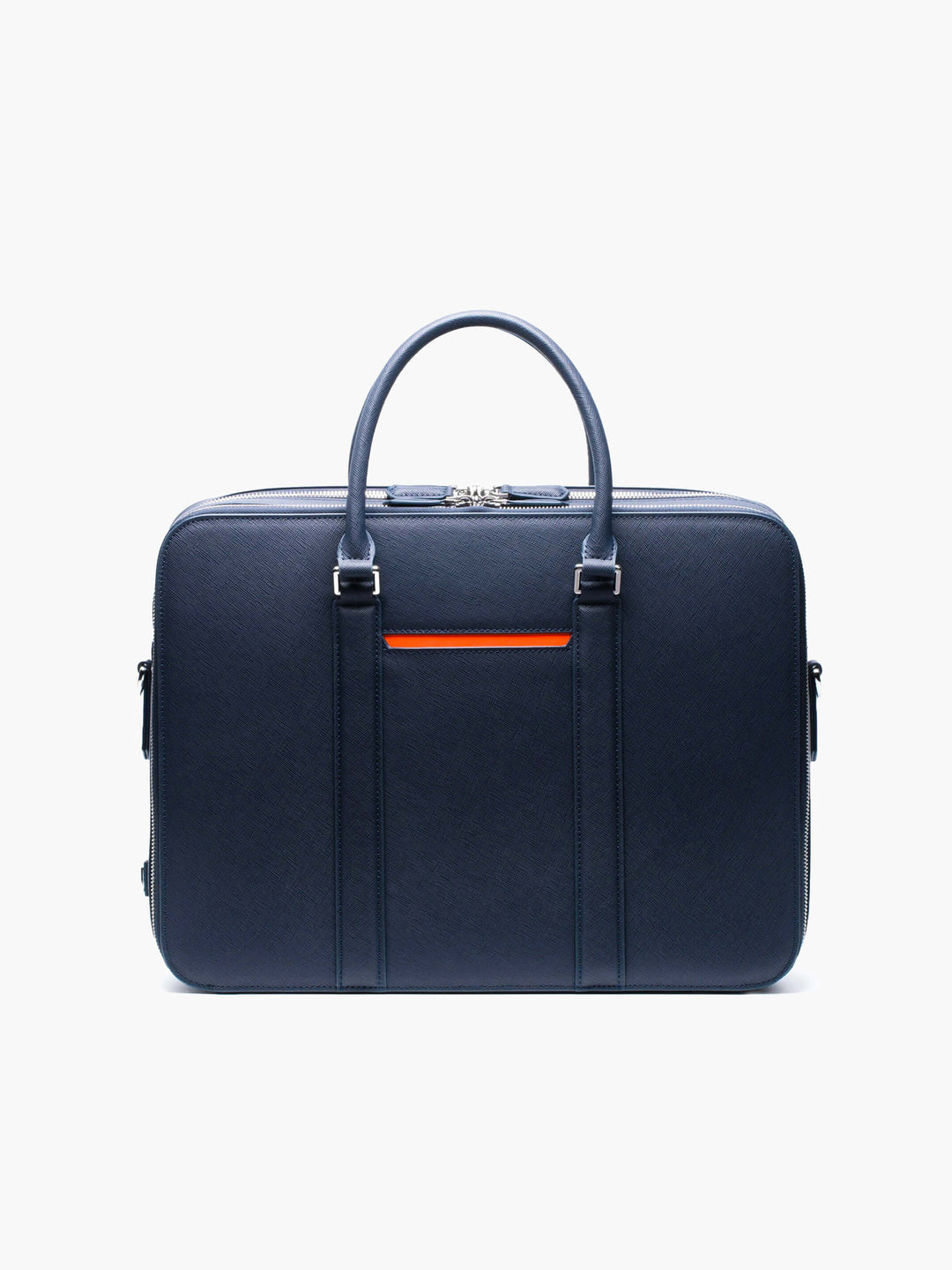
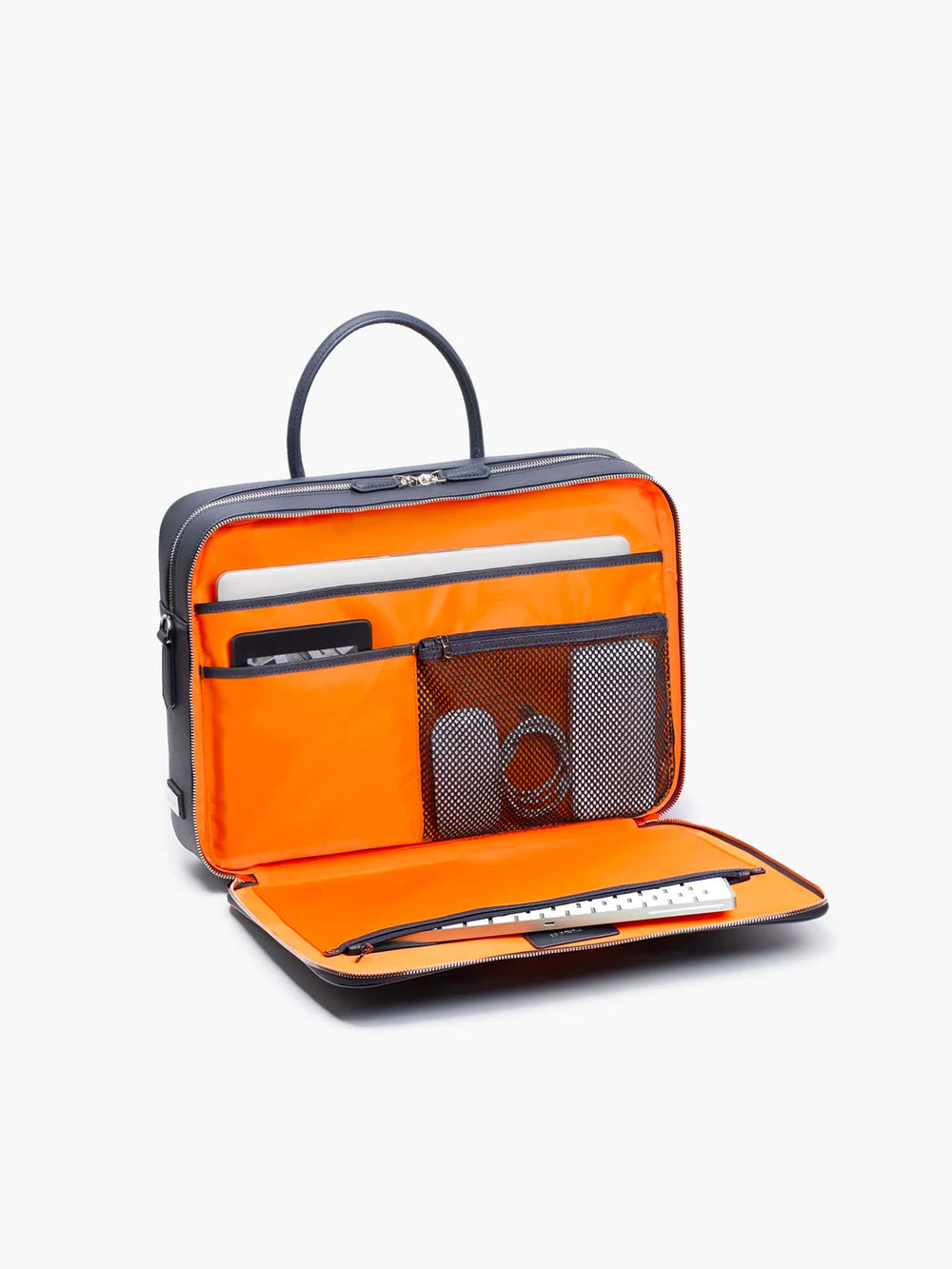
Proportion does more work than tone. The Manhattan Leather Briefcase holds 8 L across 42 x 30.5 x 9 cm at 1.2 kg, with a padded compartment for a 16-inch laptop and a scratch-resistant Saffiano surface, and that proportion is what reads as a briefcase rather than a bag, whatever colour you choose it in. If your day involves a laptop, a document bundle and gym kit, the Manhattan Double-Zip Leather Briefcase gives you 11.2 L in a 39.5 x 29.5 x 10 cm frame with a detachable shoulder strap for the walk from the station. A slim, structured mid-brown case will always read more formal than a bulging black one.

How do professionals read an office before committing to a briefcase colour?
Spend two weeks watching what the people one level above you carry and you will have your answer without asking anyone. Dress codes are now local rather than industry-wide. Post-pandemic office attire has largely settled into business casual as the default in US workplaces, and the experts Fortune spoke to in 2024 describe a workplace where fewer rules are written down and more are absorbed by observation. That makes your own floor a better source than any general guide, including this one.

Three checks professionals run before choosing a briefcase colour
Check one, the seniority scan: if two partners already carry brown, the question is closed. If every case on the executive floor is black and the firm's clients are institutional, buy charcoal and take the same benefit with none of the risk. Check two, the client roster: you are dressing for the most conservative room you enter, not the average one. Check three, the buildings: a courtroom, a central bank or a family office founded before 1950 sets your ceiling.
Tomás ran exactly this before joining a regional private equity fund. In week one he noticed the managing partner carried a mid-brown case and the two youngest analysts carried black nylon. He read it correctly. Brown was not a risk at that firm, it was the senior signal, so he bought a dark brown case before his first investment committee. Nobody remarked on it and he never wondered about it again. Two weeks of looking replaced a year of second-guessing.
Which briefcase colour suits your professional archetype?
Match the colour to the shape of your week rather than to your job title. Four archetypes cover most professionals, and each one points at a different tier of the table above.
Courtroom and committee professionals: charcoal or espresso
Litigators, regulatory specialists and bankers presenting to boards live at the formal end. Charcoal or espresso, nothing lighter, and a slim profile so the case disappears next to a suit. The Manhattan Leather Briefcase is built for that day at 8 L in a 41.5 x 29.5 x 6.5 cm frame weighing 1.2 kg, still taking a 16-inch laptop. That 6.5 cm depth is what slides under a chair in a packed hearing room instead of blocking the aisle.


Travelling advisers: the briefcase colour that hides a hard week
Mid-brown hides scuffing better than black, which shows every mark under airport lighting. Priya, a strategy consultant on a Monday-to-Thursday client rotation, carries the Mercator Double-Zip Leather Briefcase: 10.5 L across two main compartments at 1.12 kg, in water-resistant Togo-grain vegan leather, with a luggage sleeve that fits the Mercator Carry-On and most standard handles. Laptop and laundry stay separate, and the case rides the suitcase instead of her shoulder through four cities.
Daily commuters: weight before briefcase colour
If you walk fifteen minutes from the platform twice a day, grams matter more than tone. The Motion Light Briefcase carries 10.8 L at 0.91 kg with a padded 16-inch laptop compartment and a trolley sleeve, which is roughly a full water bottle less than a heavier leather case on every walk. Choose the colour second, once you know what you are willing to carry.


Senior women: briefcase colour beyond the black attaché
This conversation usually assumes a male reader and a black attaché, which has served women in senior roles badly. Tan and cognac work in exactly the same way, and the format often works better as a tote. The Manhattan Leather Tote holds 18 L at 0.83 kg with a padded 16-inch laptop compartment, a top-zip closure and a detachable shoulder strap, which covers a court hearing, a school run and a client dinner in the same day.

Why does the same tan briefcase colour look boardroom-ready on one hide and casual on another?
Finish decides formality more than colour does. Two briefcases in an identical tan can sit two tiers apart, and the variables are grain, sheen, hardware tone and edge treatment.
Grain, sheen and hardware: the briefcase colour multipliers
Grain first. A tight, uniform, pressed grain such as Saffiano or a fine Togo reads structured and corporate, because the surface is regular and the case holds its shape when set down. A loose, heavily milled or distressed grain reads artisanal, which is charming and wrong for a due diligence meeting. Sheen next: a low satin lustre is the formal register, high gloss looks synthetic under fluorescent office lighting, and chalky nubuck or suede reads weekend however dark it is. Hardware is the quiet variable most people miss. Matte or brushed metal keeps a light hide serious, while bright polished fittings tip tan toward fashion. Edges last: painted and sealed looks finished, raw and fraying looks casual.
Picture two consultants arriving at the same 9 a.m., both with tan cases. The first is smooth-grained and satin, with matte fittings and sealed edges, and it passes without comment beside a navy suit. The second is soft and unstructured, slouching where it sits, with bright buckles and a visible patina. It is a beautiful bag and it belongs in a design studio. Same colour, opposite verdicts. So when someone tells you tan is unprofessional, what they usually mean is that the last tan bag they saw was glossy or slouched, and they blamed the colour for a finish problem.
How do professionals commit to a non-black briefcase colour without second-guessing it?
Buy the darkest version of the colour you are drawn to, and the doubt disappears in a fortnight. Almost every regret in this category comes from going one shade too light, not from choosing brown over black.
Four checks before you commit. Hold the candidate against your two most-worn suits, not the aspirational one at the back of the wardrobe. Hold it against your shoes, and if the case is warmer than every pair you own, go deeper. Look at it under office lighting rather than shop lighting, which flatters warm tones by about a shade. Then load it with what you genuinely carry, because a case that bulges loses the crisp outline that makes a mid-tone look formal. Structure and capacity earn their keep here: the Manhattan Double-Zip Leather Briefcase holds 11.2 L across 39.5 x 29.5 x 10 cm at 1.6 kg, with a padded 16-inch compartment and a detachable shoulder strap, so a laptop, charger, document bundle and notebook go in without the front panel distorting.
Then carry it for ninety days without alternating. James, a corporate finance director who hesitated for a year, bought a dark brown case in January and had exactly one comment on it, from a client who asked where it came from. That is the realistic outcome. The credibility cost people fear is largely imagined, and the upside is small but real: a bag that suits your wardrobe rather than defaulting past it.
If you are shortlisting, start with the formality tier your hardest meeting demands, then narrow by capacity and weight. Browse the full briefcase range when the decision has settled. It will keep.
| Colour | Formality tier | Best suit pairings | Office environment suitability | Seasonal range | Where it falls down |
|---|---|---|---|---|---|
| Black | Tier 1 (most formal) | Charcoal, navy, black; black shoes only | Law, banking, government, regulatory hearings | All year | Anonymous; shows scuffs and dust; clashes with brown shoes |
| Charcoal grey | Tier 1 | Navy, mid-grey, charcoal; black or oxblood shoes | Conservative corporate; safe substitute for black anywhere | All year | Reads cool against warm brown or tan tailoring |
| Espresso / dark brown | Tier 1-2 | Navy, mid-grey, brown check; brown or oxblood shoes | Law, finance, accountancy, professional services | All year, strongest autumn to winter | Needs brown or oxblood footwear to look deliberate |
| Mid-brown / cognac | Tier 2 | Navy, light grey, unstructured blazers; tan or brown shoes | Corporate offices, consulting, in-house, client-facing sales | Spring through autumn | Too warm for courtrooms and formal regulatory settings |
| Tan | Tier 2-3 | Navy, light grey, beige and chino combinations; tan or light brown shoes | Business-casual corporate, tech, marketing, creative-adjacent | Spring and summer | Reads casual in soft or unstructured finishes; wrong with black shoes |
| Olive | Tier 3 | Grey, navy, earth-tone separates; brown or dark tan shoes | Tech, design, media, architecture, start-ups | Autumn and spring | Out of place in traditional law and finance |
Frequently asked questions
Is a brown briefcase acceptable in a law firm?
In most law firms, yes. A dark brown or espresso briefcase reads at the same formality tier as black, provided the leather is deep in tone, smooth in grain and structured in shape. Pair it with brown or oxblood shoes rather than black. Keep charcoal grey or black for courtroom appearances and regulatory hearings, where the most conservative option is still safest.
What briefcase colour goes with a navy suit?
Navy is the most forgiving suit colour for a bag. Black, charcoal grey, espresso brown, mid-brown and cognac all work with navy tailoring, and tan works if the finish is smooth and the shoes are brown or tan. The one combination to avoid is a light tan case with black shoes, which looks unplanned rather than deliberate.
Does my briefcase have to match my shoes and belt exactly?
No exact match is needed, and attempting one usually looks worse. Aim for the same family and a similar or slightly deeper tone: a mid-brown case above oxblood or dark tan shoes reads as coordinated. The rule that matters is warmth. Your bag should not be noticeably warmer or lighter than the shoes and belt you wear with it.
Is a tan briefcase too casual for a client meeting?
It depends on the client and the finish. A smooth-grained, satin tan case with matte hardware and sealed edges passes in most corporate offices and at client dinners. A soft, glossy or slouching tan bag reads casual whatever the meeting. Avoid tan for courtrooms, regulatory hearings and first meetings with institutional or long-established family clients.
Which briefcase colour hides scratches and wear best?
Mid-brown and cognac hide scuffs and dust best, which is why they suit heavy travel weeks, while black shows every mark under airport and office lighting. Finish helps more than colour: a scratch-resistant Saffiano or fine Togo grain recovers from a knock better than a soft, unstructured hide that creases and then keeps the crease.