



Updated 2026-09-18
Why does your bag speak before you do in a client meeting?
For most client meetings, a slim leather briefcase is the safer read: it holds its shape, opens flat on a boardroom table and matches formal dress codes. A nylon backpack is perfectly professional in startup, agency and co-working rooms. Choose briefcase vs backpack by the client's room, not your commute.
Here is the uncomfortable part of client work: the meeting starts in reception, not in the room. Before you have said your name, someone has taken in your shoes, your posture and whatever is hanging off your shoulder. Research on first impressions found that a face shown for as little as 39 milliseconds was enough for people to reach a judgment about threat, while a more considered assessment, such as intelligence, needed far longer viewing. Bags are not faces. The mechanism is the same though: the fast, low-effort read lands first, and you do not get to supply the caption.
Two client meetings where the bag got in the way
None of this makes backpacks unprofessional. It makes them contextual. Consider Priya, an account manager arriving on the 34th floor of a corporate law firm for a retention pitch. Her nylon backpack is clean, expensive and well cut; nothing about it is scruffy. The problem is choreography. She pulls it off her shoulders at the lift, holds it by one strap while she signs in, then parks it on the carpet because the meeting room has nowhere to put it. She spends the first ninety seconds managing an object instead of reading the client's mood.
Now flip it. Daniel, a fintech founder, walks into a Series A pitch with a structured leather case. The room is four engineers in hoodies and a partner in trainers. He is not underdressed, he is over-signalled, and he burns his opening minute being teased as the suit in the room.
If you are unsure which rule applies, you are not behind. Reporting on return-to-office dressing found professionals genuinely uncertain about what counts as appropriate now, because one dress code has fragmented into a dozen local ones. There is no universal bag. There is only the room you are walking into.

What makes a bag work in a client meeting? Four factors
Strip away the brand arguments and a client-meeting bag is judged on four things.
Structure comes first. A bag that holds its shape when you set it down looks deliberate; a bag that slumps looks like luggage. A rigid, low-volume case reads more formal than a soft one in the same material, and an overpacked backpack reads worse than a half-empty one.
Carry position is second. Anything held in the hand or worn on one shoulder sits in the same visual register as a suit jacket. Anything worn on both shoulders sits in the register of transit. That is not a moral judgment, it is what your eye has been trained on. It also explains why so many people arrive carrying their backpack by the top handle: they already sensed the problem.
Third is condition. A scuffed corner on a leather case reads as use; a frayed strap or a water-stained nylon panel reads as neglect, and clients extend the same inference to your work. Mark, a corporate finance associate, carried a bag that was technically appropriate and visibly tired. He was already the youngest person in the room, and the bag made him look like he had not been trusted with a budget yet.


Can you open it at the client's table?
The fourth factor is the one people forget: table behaviour. Can you open the bag at the table, take out a laptop and a printed agenda, and close it again without unpacking your gym kit onto a client's boardroom surface? A bag that cannot do that quietly will undermine you at the exact moment everyone is watching your hands. Get those four right and format matters far less than you think.

Saffiano leather briefcase vs nylon backpack: how do they compare?
Both formats can be correct. They are optimised for different halves of your day, and the trade is honest rather than hidden.
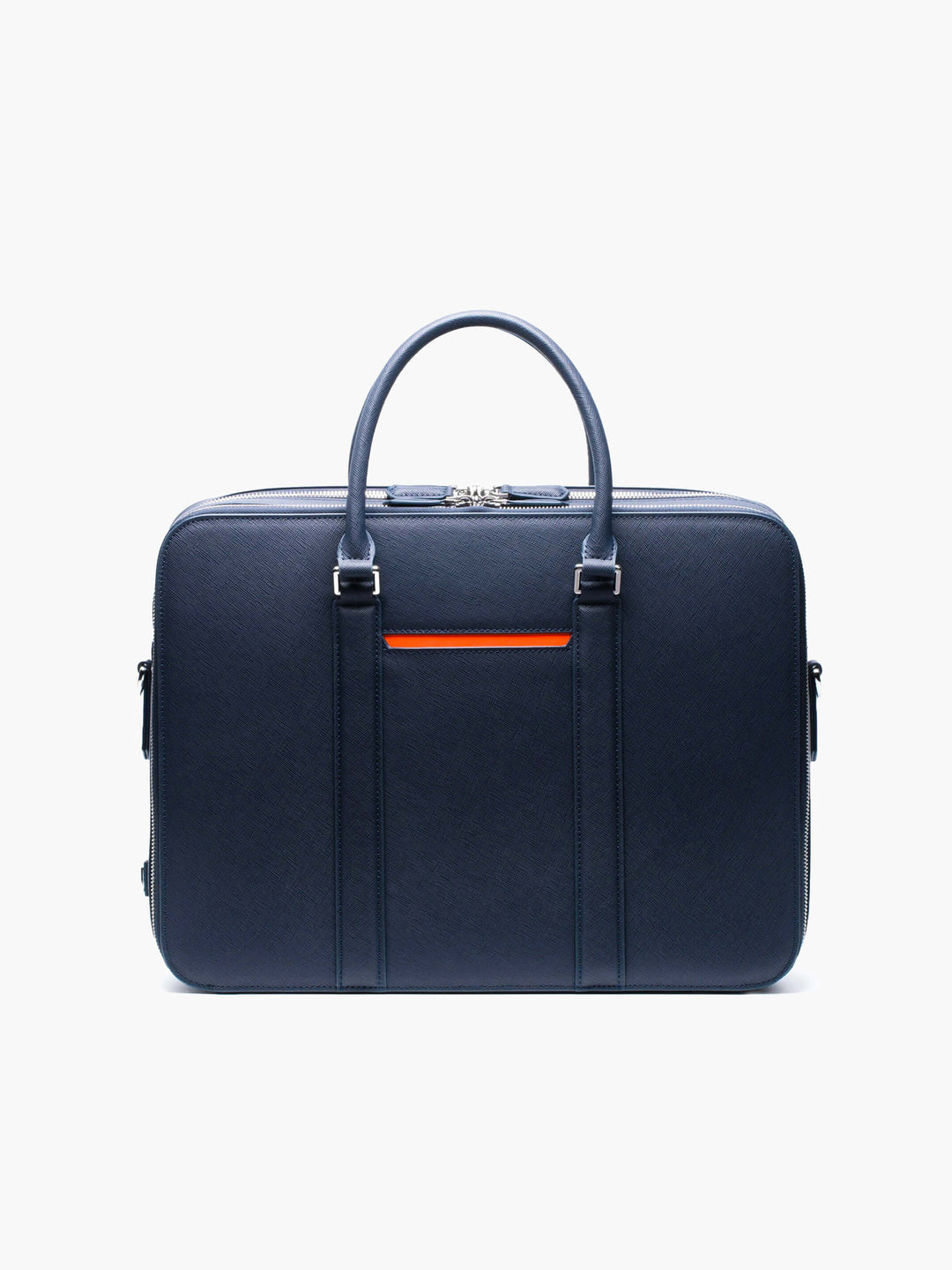
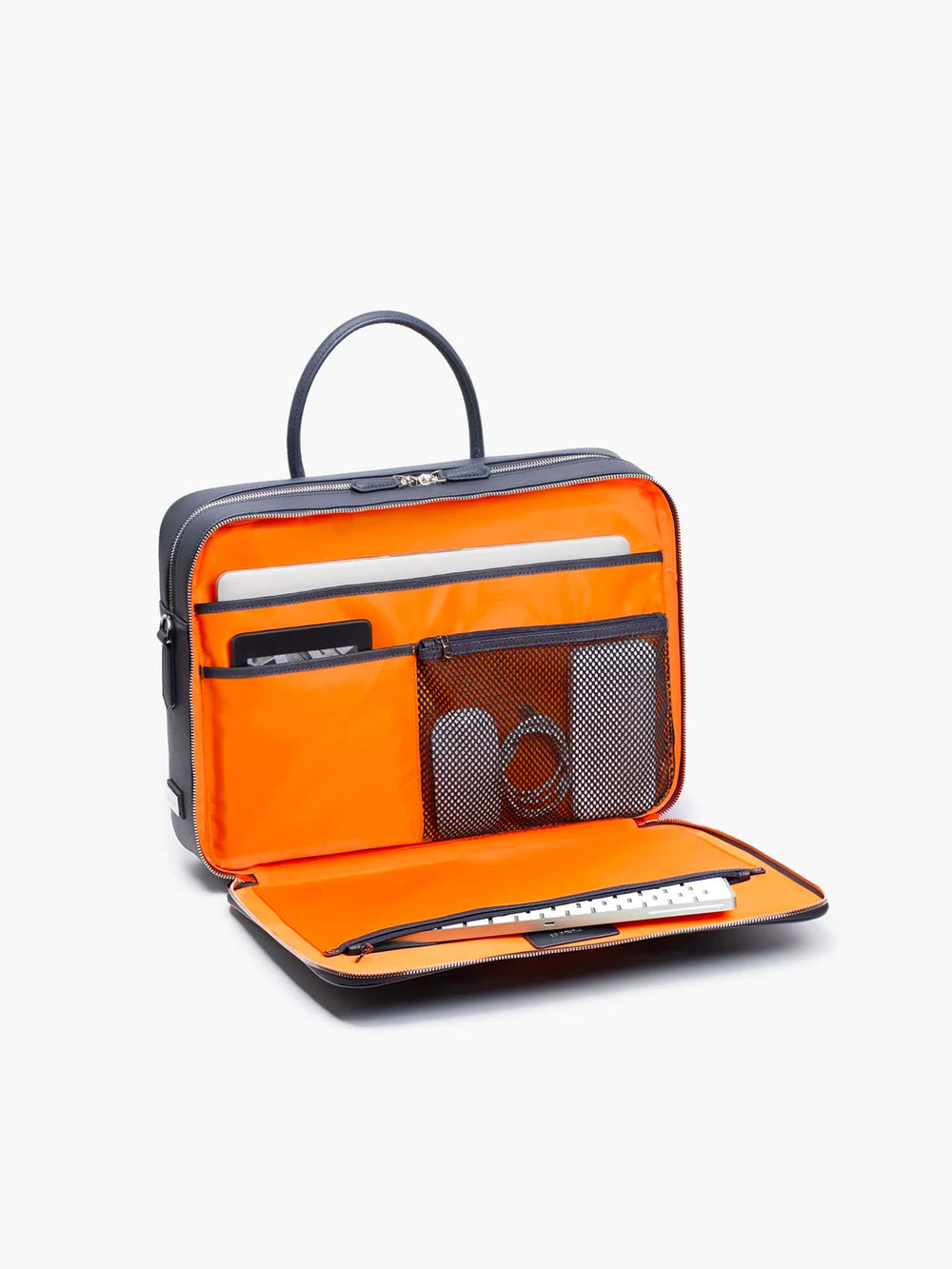
A Saffiano leather briefcase is a meeting instrument. The Manhattan Leather Briefcase is the purest version of the idea: 4.1 L across a 6.5 cm depth, 1.2 kg, and still rated for a 16-inch MacBook Pro. The slimness is the point. It forces you to carry only what the meeting needs, which is why it lands on the table looking composed rather than crammed. If your meeting days also involve a keyboard, a mouse and a charger, the Manhattan Double-Zip Leather Briefcase takes the same Saffiano shell out to 11.7 L at 1.6 kg, with a large zip pocket sized for a keyboard and a suitcase sleeve for travel days.
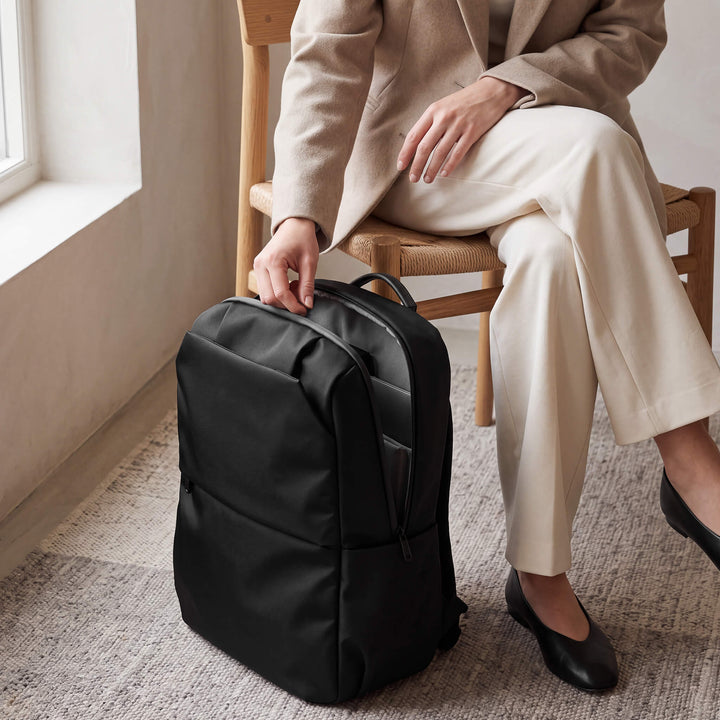
A nylon business backpack is a commute instrument that can behave itself in a meeting if you choose it carefully. The Motion Business Backpack balances sleek mobility with heavy-duty utility, offering dual laptop protection for up to a 16-inch MacBook Pro, dedicated organization for A4 documents, and quick-access exterior storage for your daily essentials. That is a genuinely useful working day: bike or train in, tech plus paperwork plus hydration, nothing crushed. What it will not do is disappear in a room full of tailoring.
So the real comparison is not quality against quality. It is formality signal against carrying capacity, and how much of each your week demands.


Briefcase vs backpack, side by side
The table below sets the two formats against the seven things client-facing buyers actually ask about, with catalogue capacities and weights rather than adjectives. Read the bottom two rows first: they tell you which format should be your default and which should be the exception.
Briefcase or backpack: reading the client's room by meeting type
This is where the decision gets easy, because the room tells you what it wants.
The law firm or professional services boardroom: assume conservative until proven otherwise. Partners, in-house counsel and finance clients read the leather case as the default of their own tribe, and a slim one like the Manhattan Leather Briefcase at 1.2 kg and 6.5 cm deep slides onto the table without displacing anyone's papers. Verdict: briefcase, every time, and do not overfill it.
The agency creative brief: softer, still client-facing, and you are usually carrying more. Printouts, a tablet, sometimes a sample. A structured vegan leather case with real volume works here, which is the argument for the Axis Leather Briefcase at 11.2 L and 1.24 kg, with a 16-inch laptop slot and a detachable padded shoulder strap for the walk between two client offices in one afternoon. Verdict: a hand-carried case, but choose capacity over minimalism.
When the backpack is the fluent choice in a client meeting
The startup pitch is the clearest case. Here a backpack is not merely acceptable, it is often more fluent, provided it looks engineered rather than outdoorsy. The Montreal Business Backpack in high-performance vegan leather, 15 L at 1.12 kg with a padded 16-inch laptop slot, an A4 and iPad slot, and an anti-theft pocket, sits comfortably in a room of founders.
The co-working check-in is easier still. Nobody there is evaluating your formality; they are evaluating whether you can set up and work in four minutes. Lightness wins. The Alight Slim Backpack carries 22 L at 0.8 kg in recycled nylon, holds a 16-inch MacBook Pro on a retainer strap and keeps cables in a zip mesh pocket, so you are not excavating at a shared desk.
One rule covers all four rooms: when you genuinely cannot tell, dress the bag one notch above the room. Marginally too formal is a forgettable mistake. Too casual is the one people remember.
How do you carry client meeting notes and an agenda without fumbling?
Most client-meeting embarrassment is not about format. It is about fumbling. You are three minutes in, the client asks for the figure on page two of the agenda, and you are elbow-deep in a main compartment with your notebook under a charger.
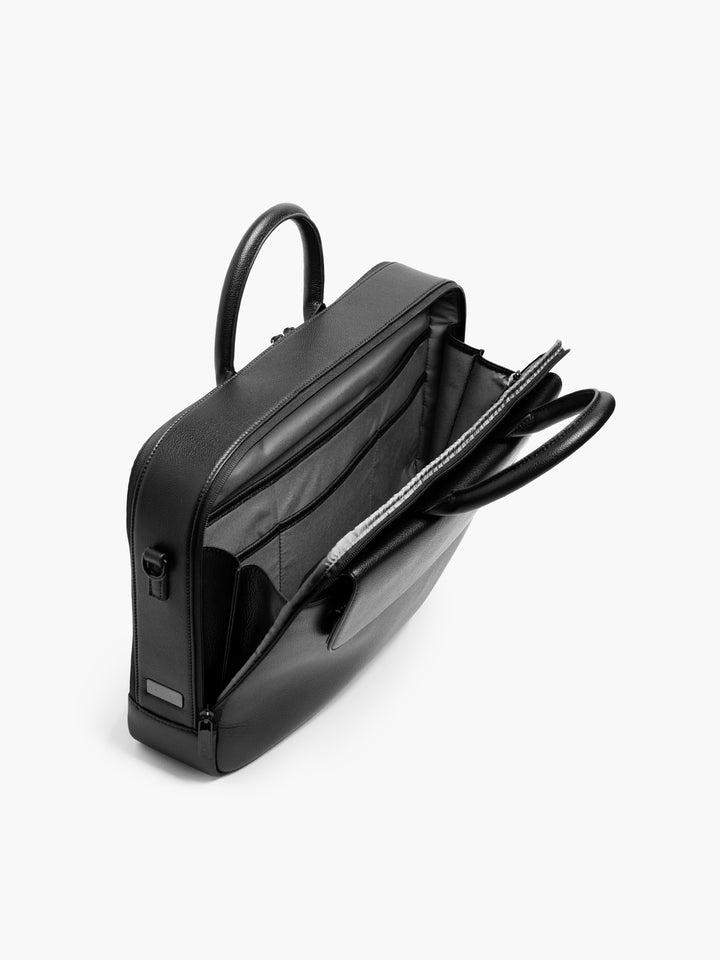
Fix it with layout rather than willpower. Printed agendas and meeting notes want a flat, full-width slot you can reach without opening the compartment that holds everything else, which is what a dedicated A4 sleeve is for. Briefcases tend to win here structurally, because their contents stay stacked in the order you loaded them. A backpack's main compartment is a vertical well, so gravity reshuffles your paperwork every time you walk. If you carry a backpack to client work, load documents into the dedicated document slot rather than the main cavity, and accept that you will need to set the bag on a chair, not the floor, to get into it gracefully.
Then there is the notebook question. A tablet is quieter to carry but slower to reference mid-sentence; paper is faster to flip and reads as more attentive to clients who grew up on it. Whichever you choose, it lives in its own slot, never loose. Sarah, a management consultant running four client sessions a day, keeps a fixed drill: agenda in the front-most flat pocket, notebook in the document slot, pen in a pen loop, laptop stays put until it is asked for. She looks prepared because the bag makes her prepared.
The test: sit down and have the agenda in your hand within five seconds, with nothing else visible on the table. If your current bag cannot pass that, the layout is wrong, not you.
When should you own both a briefcase and a backpack?
At some point you stop hunting for the one bag that does everything and admit you have two kinds of day. That is a career-stage observation, not a shopping upgrade. Junior roles have one mode: get to the office, work. Client-facing roles have two: the day you are seen, and the day you are moving.
Owning both is cheaper than it sounds, because the second bag only has to cover what the first cannot. If your default is a formal case, the companion is a weather-resistant carrier for travel, gym days and laptop-plus-everything commutes. If your default is a backpack, the companion is a slim case for the eight or ten genuinely formal meetings you have a year.
Two rules make a two-bag rotation work. Size both to the same laptop, so swapping is a thirty-second job and not a repack. And keep the small items in pouches that move as units, so cables, chargers and cards travel between bags together instead of getting orphaned. Tom, an account director, does his swap on Sunday evening: he checks the week's calendar, sees three internal days and one client pitch, then sets out the case for Thursday and the backpack for everything else. He has never arrived at a client's office with the wrong bag, because the decision was made when he was calm.
The point of a second bag is not more choice. It is fewer decisions on the mornings that matter.

Briefcase vs backpack: which one fits your working week?
Count your client meetings. Not the ones in your own office: the ones where you walk into someone else's building. That number decides your format.
Two or more a week, in corporate, legal or financial settings? Buy the briefcase first and make the backpack the exception. The Manhattan Leather Briefcase at 4.1 L and 1.2 kg is the right shape if your carry is a 16-inch laptop, a notebook and paper. The Manhattan Double-Zip Leather Briefcase at 11.7 L and 1.6 kg is the one if peripherals and a change of plan come with you.
One client meeting a fortnight, with the rest of the week spent commuting, co-working or travelling? Lead with a backpack and keep a case ready. The Windsor Business Backpack gives you 20 L at 1.37 kg with a 16-inch laptop compartments for the ordinary days, and the Vista Waterproof Briefcase at 8.8 L and 0.81 kg covers the formal ones without the weight of a leather case.
Mostly startup, creative or scale-up clients, with a long commute? Stay with a backpack and buy the better version of one. The Alight Slim Backpack at 22 L and 0.8 kg is the lightest way to carry a full working day, and the Maximus Leather Backpack at 21 L and 0.9 kg handles wet weather and a 16-inch laptop with a silhouette that does not look like a weekend.
And if you are in Priya's position, with a pitch next week and no time to think it through, take the case. One meeting is not the moment to test a theory about how relaxed the client is. Every briefcase and backpack here is built around the same 16-inch laptop fit, so you can change your mind about format without changing anything else you carry.
| What you are judging on | Saffiano leather briefcase | Nylon business backpack |
|---|---|---|
| Formality signal | Reads as the default in legal, finance and corporate rooms. Hand-carried, so it sits in the same register as tailoring. | Reads as competent transit. Fine in startup, agency and co-working rooms; conspicuous in a boardroom of suits. |
| Meeting-readiness | Opens flat on the table and stays stacked in loading order. Example: Manhattan Leather Briefcase, 4.1 L across a 6.5 cm depth, 1.2 kg, fits a 16-inch MacBook Pro. | Needs a chair or a table to open gracefully. Example: Insight Business Backpack, 18.9 L, 1.2 kg, two laptop compartments for a 16-inch MacBook Pro. |
| Comfort on commute | One shoulder or one hand. Fine for a taxi, a short walk or a train seat; less so for 40 minutes on foot or a bike. | Weight split across both shoulders with a breathable back panel. The better choice for long, physical or multi-stop commutes. |
| Organisation for notes and agenda | Flat A4 and document slots plus pen slots, so a printed agenda comes out in one movement without disturbing anything else. | Vertical main compartment reshuffles loose paper as you walk. Use the dedicated A4 and iPad slot, not the main cavity. |
| Versatility across environments | Formal to smart-casual. Struggles at the gym, on a flight with hand luggage, or on a heavy travel day. | Commute, travel, co-working and weekend. Struggles only at the top end of the formality scale. |
| Capacity and weight, in the catalogue | 4.1 L at 1.2 kg (Manhattan Leather Briefcase) up to 11.7 L at 1.6 kg (Manhattan Double-Zip Leather Briefcase). | 16.8 L at 1.12 kg (Level Commuter Backpack) up to 22 L at 0.8 kg (Alight Slim Backpack). |
| Best for | Two or more client meetings a week in someone else's corporate building. | One client meeting a fortnight, with commuting, travel or co-working filling the rest of the week. |
Frequently asked questions
Is it unprofessional to bring a backpack to a client meeting?
No. A backpack is fine in startup, agency, tech and co-working settings, where it reads as competent transit rather than casual. It becomes conspicuous in legal, finance and corporate boardrooms, where a hand-carried case is the local default. If you cannot tell which room you are entering, carry the briefcase: being slightly too formal is forgettable, being too casual is not.
What bag size do I need for a 16-inch MacBook Pro?
Check the stated laptop compartment rather than the overall litres. Maverick & Co bags rated for a 16-inch MacBook Pro include the Manhattan Leather Briefcase at 4.1 L and 1.2 kg, the Insight Business Backpack at 18.9 L and 1.2 kg, and the Level Commuter Backpack at 16.8 L and 1.12 kg. Same laptop fit, very different capacities.
Can a leather briefcase work as an everyday commuter bag?
Yes, within limits. A slim case such as the Manhattan Leather Briefcase, 4.1 L at 1.2 kg, suits a short walk, a taxi or a train seat, but one-shoulder carry gets tiring past roughly 40 minutes on foot or on a bike. If your commute is long or multi-stop, commute in a backpack and keep the case for the days you are seen.
How much should a client-meeting briefcase weigh?
Aim under about 1.5 kg empty, because whatever you load sits on top of that. For reference, the Manhattan Leather Briefcase is 1.2 kg, the Axis Leather Briefcase 1.24 kg, and the Vista Waterproof Briefcase 0.81 kg at 8.8 L. Weight matters most when you are carrying by hand through a lobby and a lift before you shake anyone's hand.
Should I buy a briefcase or a backpack first?
Count the meetings you attend in someone else's building. Two or more a week in corporate, legal or financial settings, buy the briefcase first. One a fortnight, with the rest of the week spent commuting or co-working, buy the backpack first and keep one slim case ready. Buy for the majority of your week, then cover the exception.